

What the service covers
Full storm-drain networks designed, installed and commissioned for buildings, rooftops and paved areas

Storm-drain network design
Drainage drawings with calculated pipe grades, diameters and catchment areas

Rooftop collection channels
Roof gutters and parapet outlets directing water to vertical downpipes

Vertical downpipe runs
uPVC or HDPE downpipes fixed to facades with sealed, expansion-jointed connections

Ground-level sumps and gullies
Gully pots and sump chambers with sediment traps at ground level

Connection to storm outlet
Tying the network to the approved discharge point or retention pit

Flow test and commissioning
Water-flow test confirming fall and clear passage before backfilling or plastering
Materials and methods used
uPVC storm-drain pipe
Lightweight, UV-stable when painted, joined with solvent cement or rubber-ring push-fit for secure slope-critical runs
Corrugated HDPE pipe
Flexible for buried ground runs, resisting lateral soil pressure in Kuwait's compacted limestone-rich ground
Polymer concrete channel drain
Load-rated linear channels set flush in driveways and car parks to collect surface sheet-flow efficiently
Hydraulic mortar collar sealing
Fast-set hydraulic mortar collars around every pipe penetration prevent soil ingress and future pipe joint separation
Before you call us
Locate where water pools
Note every spot on the roof, yard or driveway where water sits after rain
Check existing outlets
Check whether any current drain gullies, downpipes or outlets exist and whether they are blocked or broken
Gather building drawings
Any floor or site plans showing existing buried pipes help the design avoid clashes with supply lines
Identify the discharge point
Know whether site runoff should reach a public drain, a retention chamber, or a road kerb outlet
Inside storm-water drainage.

How a storm-drain network is done right in Kuwait
Kuwait's rainfall arrives in short, heavy bursts that generate large runoff volumes within minutes, enough to overwhelm an undersized or poorly graded network. The design stage sets the foundation: every catchment zone is calculated, pipe diameters are sized to the expected flow, and every run is given a minimum grade so water moves by gravity alone. Skipping the design and guessing the grades is the most common reason storm drains block repeatedly, because mineral-rich sediment settles wherever the pipe runs flat.
On site, linear polymer channels are set into driveways and terraces, gully pots with sediment baskets are placed at direction changes, and vertical downpipes carry roof drainage to ground level or to buried lateral runs. In existing buildings, routing is constrained by what is already buried, so the choice between pure gravity drainage and adding a collection sump with a small pump needs to be made early. Before any trench is closed or wall plastered, a full water-flow test confirms every joint holds and every pipe drains clear.
After handover, periodic clearance of sediment baskets and gully pots is critical in Kuwait's environment, where fine dust and calcite particles accumulate quickly inside collection chambers. Clearing them before and after the rainy season prevents manhole surcharge and stops runoff from pushing back toward the building. Designing storm drainage as part of the original construction or renovation plan rather than adding it later avoids conflicts with sewer lines, foundation walls and finished paving, and produces a network that needs only routine cleaning rather than repeated excavation and repair.
What goes wrong with most plumbing.
Plumbing problems start hidden and end with breaking tiles. These three cost the most.
 01
01Pipes laid in a rush
Pipework rushed before the walls close stays hidden until it starts to leak.
 02
02Leaks you cannot see
A slow leak behind tiles shows up as damp, stains and a higher water bill.
 03
03Nobody answers in an emergency
A burst pipe at night cannot wait for a contractor who has moved on.
The solution?
Pipework, leak detection and maintenance from one licensed company.
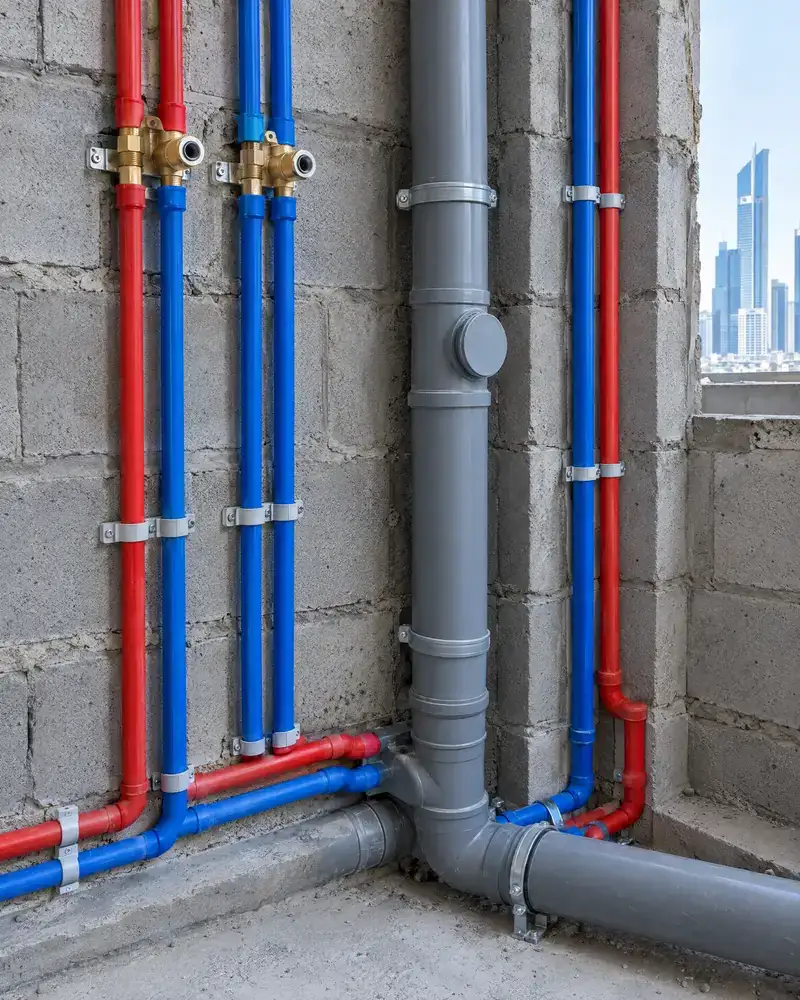
Pipes laid in a rushFirst-fix plumbing by the builder
Laid as part of the build, before the walls close.

Leaks you cannot seeWater leak detection
We find the source first.
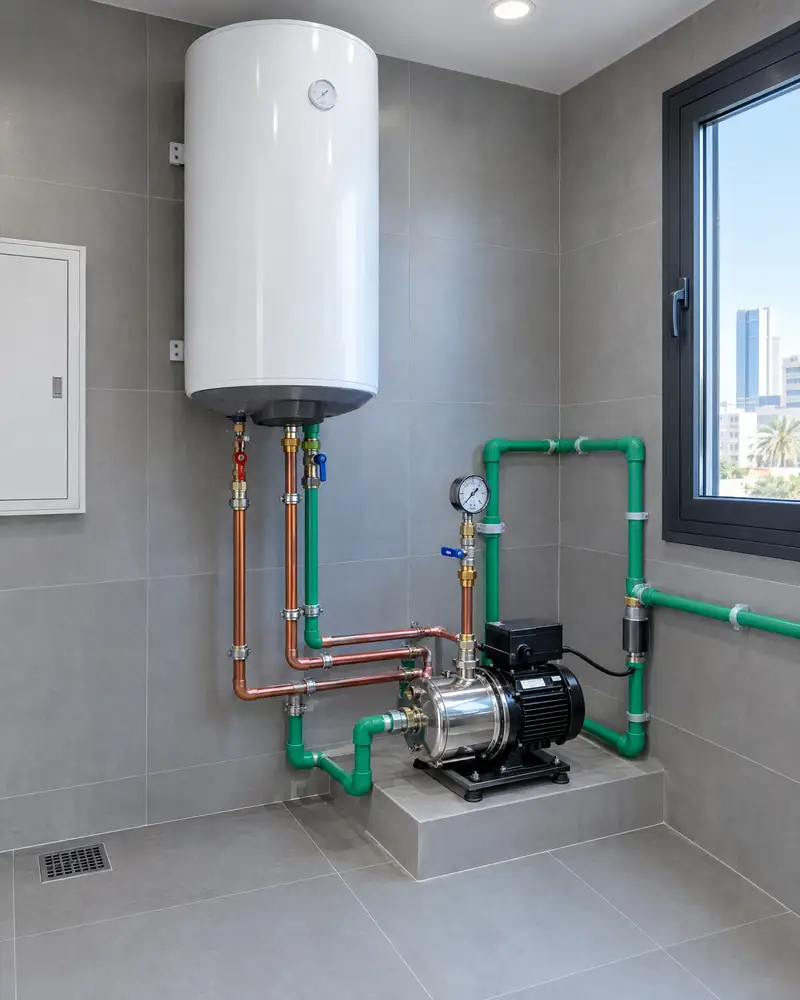
Nobody answers in an emergency24-hour emergency plumber
Plus regular maintenance contracts after handover.
How it works.
First contact
Call or WhatsApp us describing the site, its size and the drainage problem
Site survey
We visit to measure catchment areas, note levels and find existing buried services
Design and quote
We produce a drainage network drawing with a fully itemised price proposal
Installation and testing
Full network is installed, water-tested and confirmed clear before any closure
Handover
Site is handed over with maintenance notes for chambers and channel grates
What sets the price.
Quote varies with site area, network complexity, pipe depth and the civil reinstatement work required
Get a quoteCatchment area and network size
Larger rooftops and paved areas need more outlets, larger pipes and longer runs
Pipe depth and excavation
Deep buried runs require wider trenches, compacted backfill and tile or paving reinstatement
Channel and sump type
Load-rated driveway channels cost more than standard residential gully pots
Reinstatement works
Reinstating tiles, asphalt or plaster after pipe installation is a significant portion of total cost
Drainage pump requirement
Sites where gravity fall is insufficient need a collection sump and pump, adding equipment cost
Why one contractor beats four.
Every extra contractor means another schedule and another excuse. With us, one company answers for all of it.
Turnkey
Shell and finishing with one company, from footings to keys.
Pay in instalments
Construction and finishing on instalments. Ask us for the details.
Engineering supervision
Architectural drawings and engineering supervision on site.
After handover
Maintenance contracts and a 24-hour emergency plumber.
A licensed Kuwaiti company for building construction, finishing, renovation and infrastructure works.
What our clients say.
See all reviews on GoogleExcellent
Taha Saad
Google review
Excellent
Ali Nadi
Google review
Storm-water drainage in Kuwait. We work across all six governorates of Kuwait: Capital, Hawalli, Farwaniya, Mubarak Al-Kabeer, Ahmadi, Jahra.
Official references: Ministry of Electricity and Water (water and drainage connections)
Questions, answered.
Call nowIs storm drainage really necessary in Kuwait given how rarely it rains?
Rainfall is infrequent but arrives intensely, generating high runoff in minutes. Without a proper network, water soaks into walls, floods entrances and damages finishes. The repair cost after one heavy shower far exceeds the cost of a correctly designed drain system.
What is the difference between a storm-drain network and the sanitary sewer?
A storm-drain network carries clean surface runoff to a discharge point or retention pit. The sanitary sewer carries wastewater from bathrooms and kitchens. Connecting the two is a technical error that causes repeated blockages and is not accepted by the municipality.
Why do storm drains block so soon after installation?
The most common cause is insufficient pipe grade, which lets Kuwait's fine calcareous dust and grit settle inside the run. The second cause is sediment baskets that are never cleared. Correct design sets the grade to move solids through, while seasonal cleaning of gully pots prevents full blockage.
Can a storm-drain network be added to an already finished building?
Yes, but adding a network to a finished building means cutting new trenches and reinstating some tiling or plasterwork. A site survey before quoting identifies the least disruptive routing to minimise the reinstatement area and keep costs controlled.
Can storm runoff drain into a retention tank rather than a public outlet?
Yes, a retention sump or cistern is a common solution where no public storm outlet is directly accessible. The chamber is sized for the peak calculated runoff and fitted with an overflow pump. The design should meet local authority requirements for the site.
What is the minimum fall required for a buried storm-drain run?
The required grade depends on pipe diameter and expected flow volume, and is calculated in the network design drawing for each run individually. Smaller diameter pipes need a steeper fall to maintain self-cleansing velocity and stop sediment from settling on the pipe invert.
Licensed and registered in Kuwait.
Check us before you sign. This is our licence number and what it covers.
Find us on Google Maps