
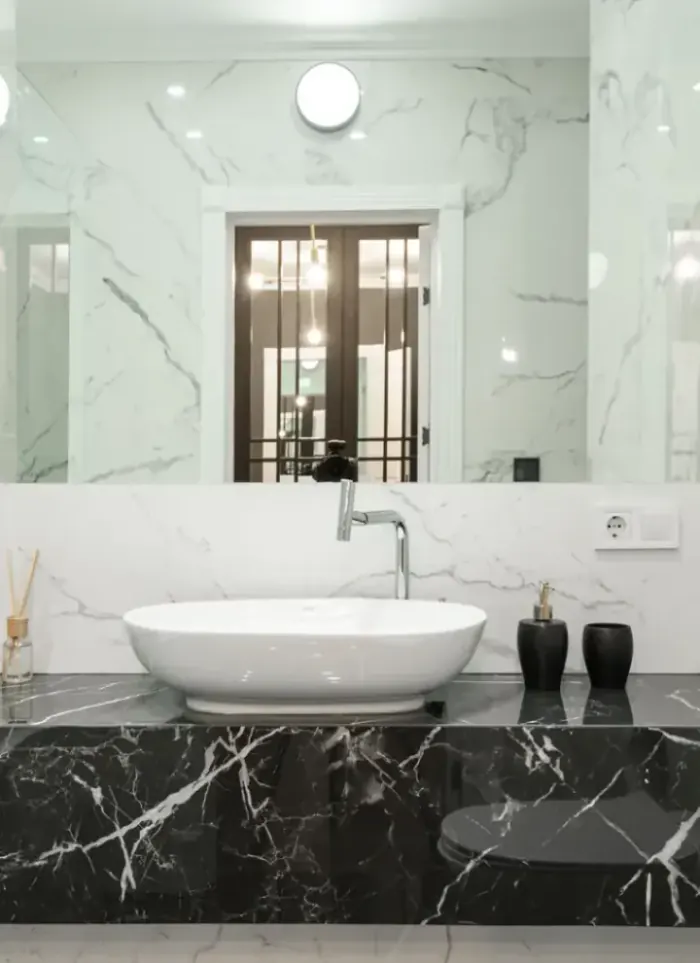
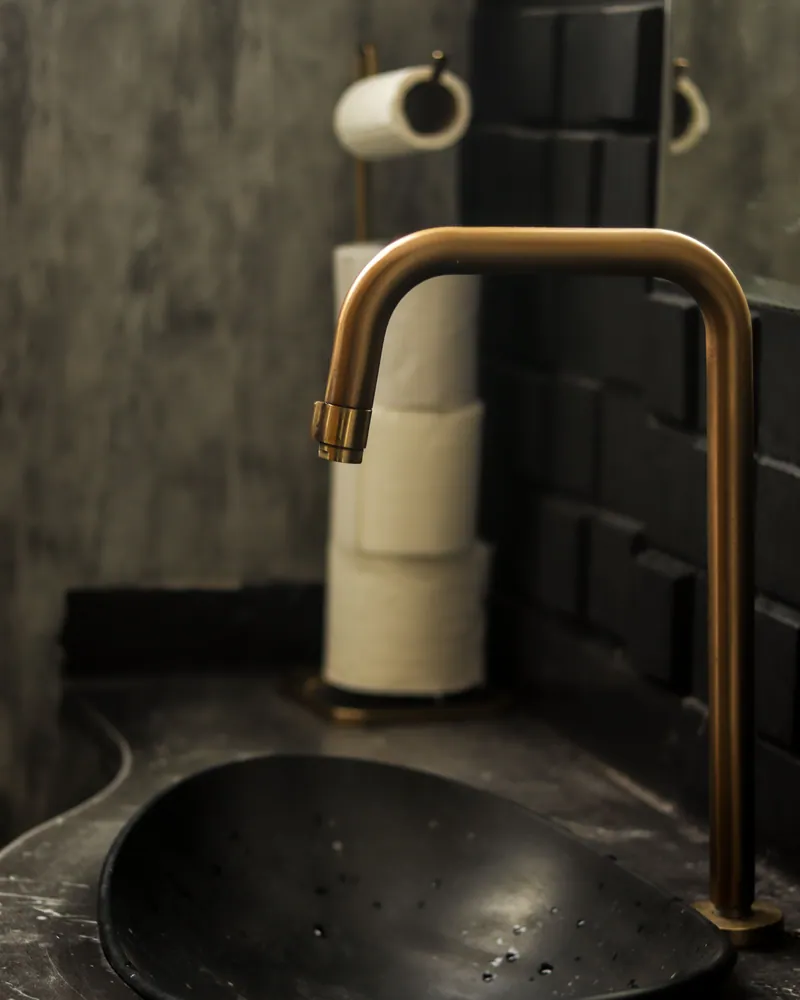
What the installation covers
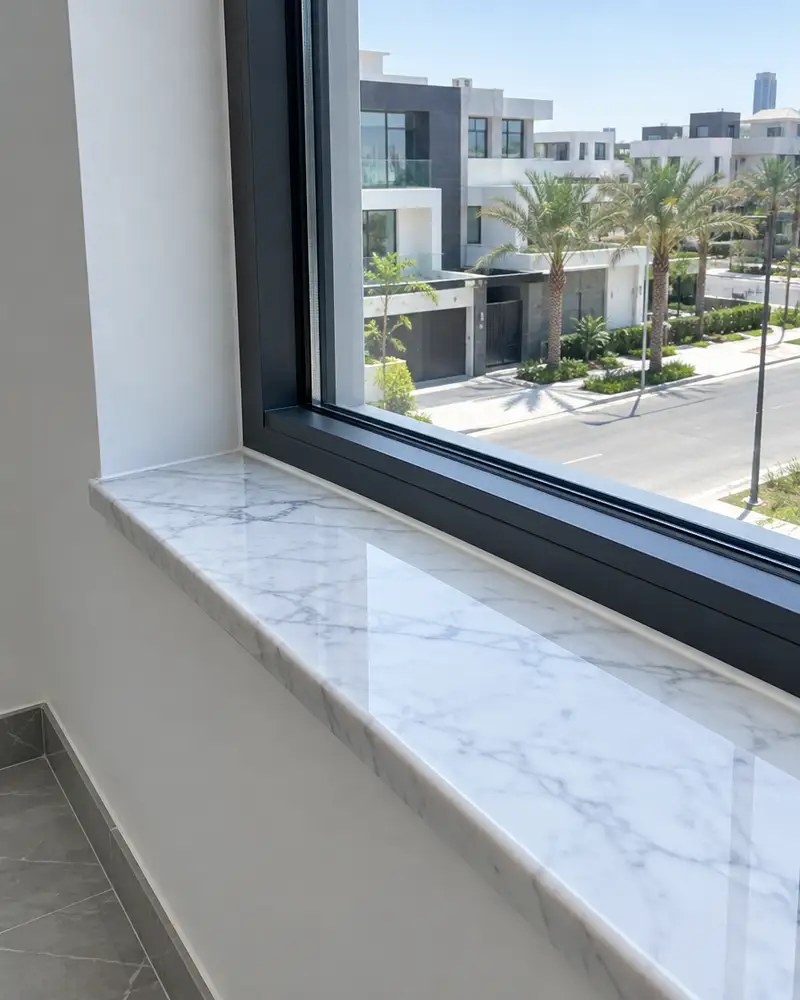
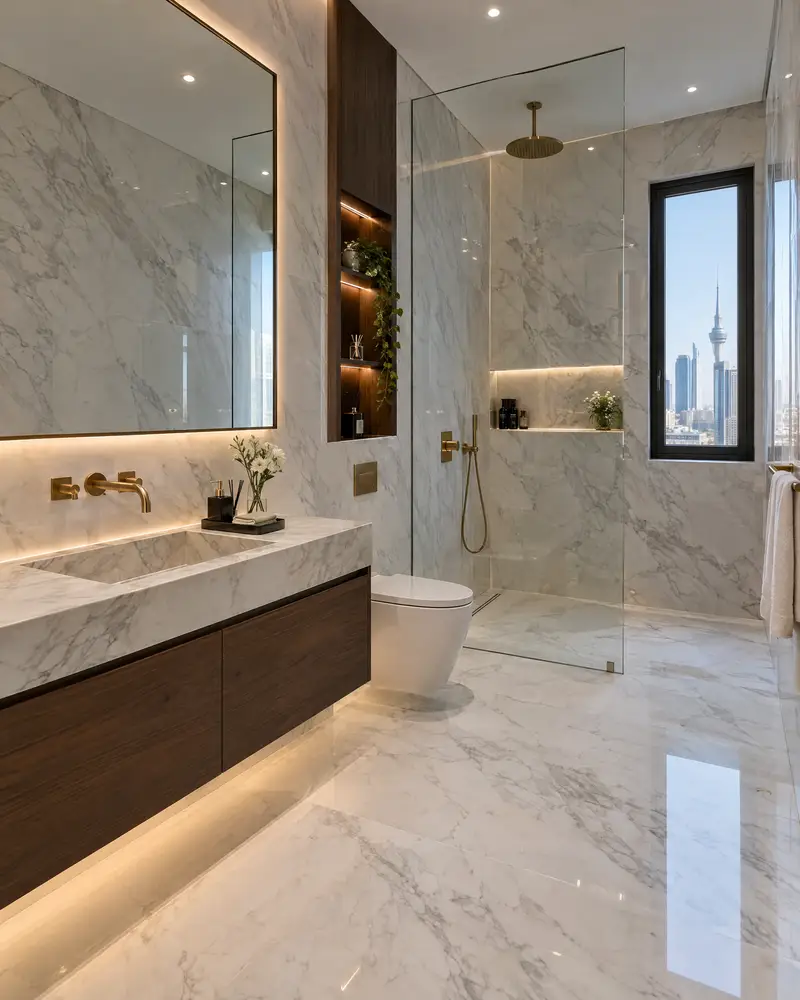
Basin support measurement through stone cutting, fixing, tap-hole profiling and sealed handover.

Support measuring
Precise measurement of the cabinet or pedestal before any cutting.

Slab cutting and shaping
Wet diamond-blade cutting and front edge profiling to the required shape.

Basin and tap holes
Circular core drilling to prevent cracking around basin or tap openings.
Mortar bed fixing
Full mortar coverage under the slab with no voids under basin weight.

Silicone edge sealing
Anti-mould silicone seals every joint between stone, basin and wall.

Sealing and final check
Stain impregnator applied and level and joint tightness verified before handover.
Materials and methods used
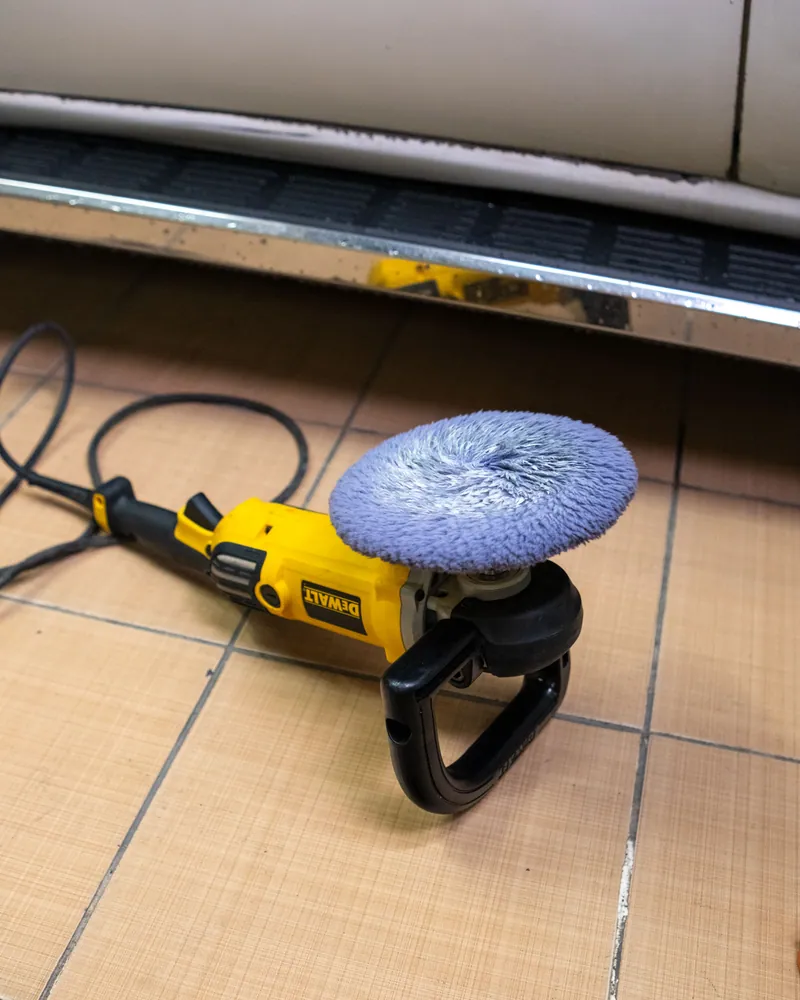
Core-drill hole cutting
Diamond core-bit drilling for the basin opening prevents cracking at the inner edge that a jigsaw or angle grinder causes.
Flexible cementitious adhesive
Flexible adhesive mortar absorbs thermal movement in bathrooms and carries the fixed basin load without cracking.
Penetrating stone impregnator
Penetrating impregnator fills the stone pores and blocks soap scum and lime scale from reaching below the surface.
Anti-mould silicone sealant
Anti-mould silicone at every stone-to-wall and stone-to-basin joint resists the persistent moisture in Kuwait bathrooms.
Common mistakes in marble basin installation
Angle-grinder opening cut
Cutting the basin opening with an angle grinder instead of a core drill leaves hidden micro-cracks that widen with daily use.
Voids in the mortar bed
Partial mortar coverage leaves hollow spots under the slab that cause cracking when weight or vibration is applied.
Skipping the impregnator
Unimpregnated stone absorbs lime and soap deposits and develops staining or yellowing within weeks of use.
Using standard adhesive at joints
Standard adhesive instead of anti-mould silicone at basin edges produces visible black mould growth in a humid bathroom.
More in marble & granite.

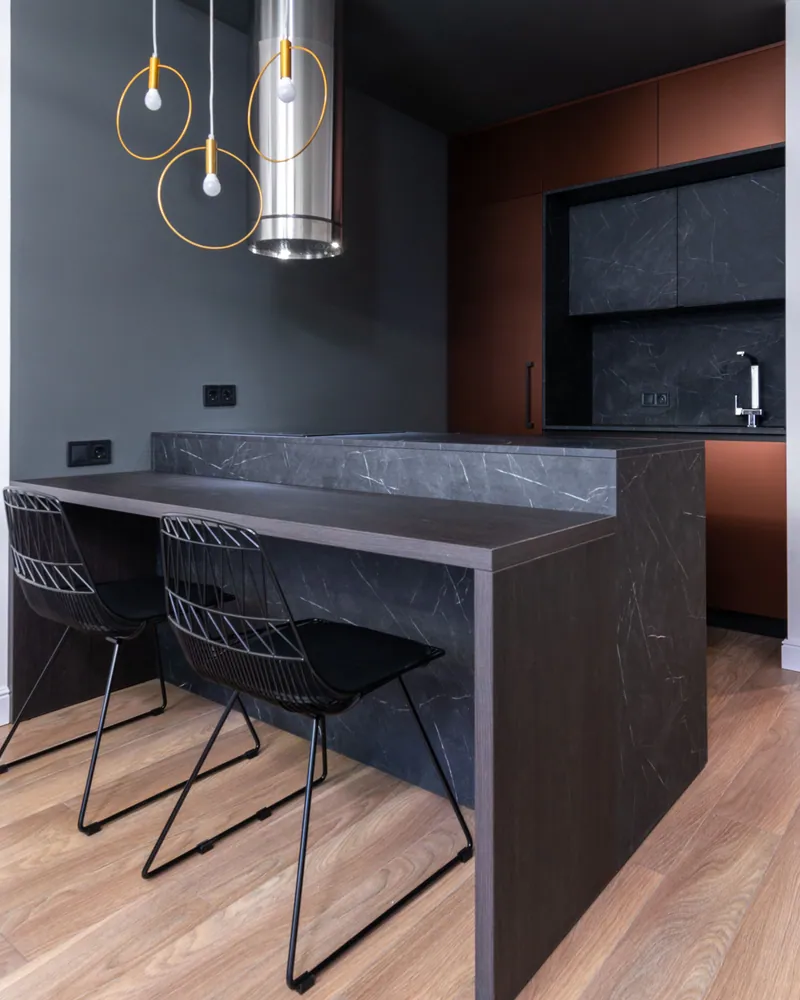


What goes wrong with most finishing.
The finish is what you see every day, and its mistakes do not hide. These three are the most common.
 01
01A rushed finish
The finish is what you live with every day. Rushing it shows in every corner.
 02
02Four contractors for one finish
Tiling, gypsum, paint and aluminium crews who never talk to each other.
 03
03After-care that never comes
Once you have the keys, it is hard to find anyone to come back and fix what shows up.
The solution?
Full finishing, and maintenance after it, from one licensed company.
A rushed finishTurnkey finishing
Marble, tiling, gypsum and paint from one company.

Four contractors for one finishOne company for every trade
No gaps between the tiler, the gypsum crew and the painter.

After-care that never comesRegular maintenance after handover
And finishing on instalments if you need it.
How it works.
Call or whatsApp
Call or WhatsApp us and share a photo of the existing basin or cabinet.
Site measure and check
Site visit to measure the support, check the wall condition and drain position.
Stone selection
We present suitable stone samples and you choose the type and edge profile.
Cutting and fixing
Slab cut, basin and tap holes core-drilled, then full mortar bed fixing.
Seal and handover
Stain impregnator applied, anti-mould silicone sealed at joints and basin handed over ready for use.
What sets the price.
No fixed rate applies because these 5 factors together determine the actual quote.
Get a quoteStone type and grade
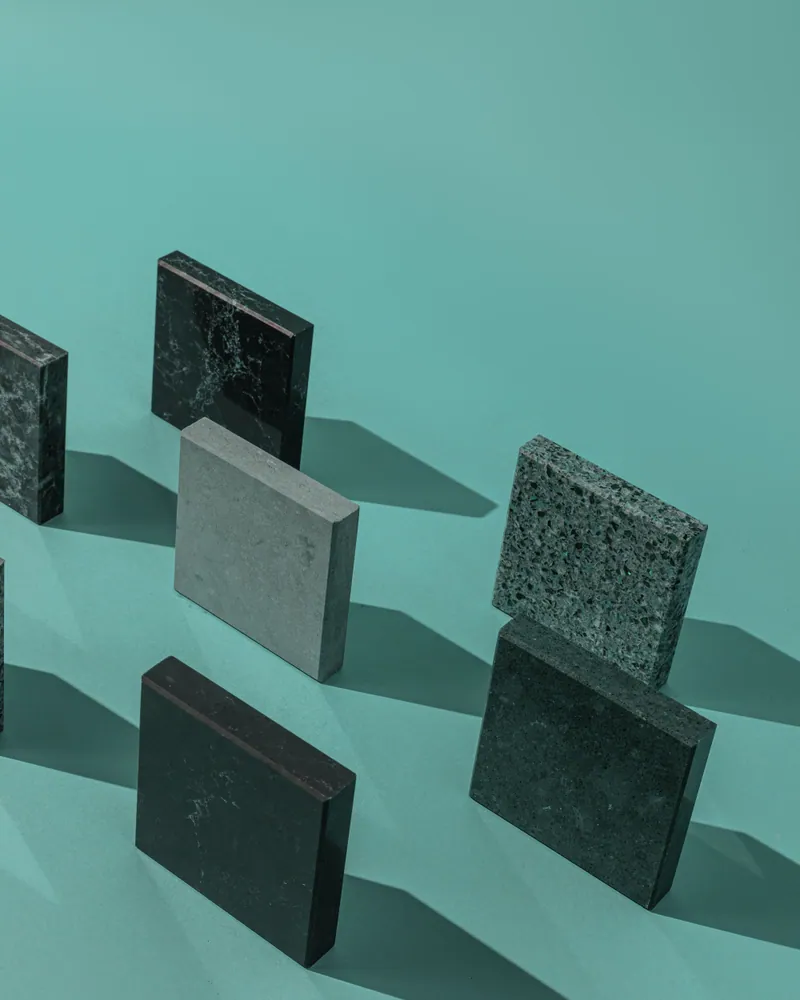
White premium or Italian marble costs more than locally sourced stone options.
Slab dimensions and shape
Double-basin tops or curved corners require more cuts and raise the labour cost.
Front edge profile
A bullnose or ogee profile takes longer to grind and finish than a straight chamfered edge.
Removal of the existing top
Breaking out and removing an old marble or corian surface adds extra labour and disposal cost.
Basin count and site locations
Multiple basins on different floors raises transport and preparation cost per location.
Why one contractor beats four.
Every extra contractor means another schedule and another excuse. With us, one company answers for all of it.
Turnkey
Shell and finishing with one company, from footings to keys.
Pay in instalments
Construction and finishing on instalments. Ask us for the details.
Engineering supervision
Architectural drawings and engineering supervision on site.
After handover
Maintenance contracts and a 24-hour emergency plumber.
A licensed Kuwaiti company for building construction, finishing, renovation and infrastructure works.
What our clients say.
See all reviews on GoogleExcellent
Taha Saad
Google review
Excellent
Ali Nadi
Google review
Marble basins in Kuwait. We work across all six governorates of Kuwait: Capital, Hawalli, Farwaniya, Mubarak Al-Kabeer, Ahmadi, Jahra.
Official references: Kuwait Fire Force (safety requirements in finishing work)
Questions, answered.
Call nowCan a new marble basin top be fitted over the existing cabinet without replacing it?
Yes, provided the cabinet is solid and level. We measure it, cut the new slab to fit and remove only the old top without touching the cabinet structure.
Why does yellowing appear around the basin edge a short time after installation?
Yellowing usually comes from an unsuitable sealant or a missing impregnator coat. Kuwait's hard water accumulates in unsealed pores and discolours the stone around the basin rim.
What makes one marble type more suitable for a basin top than another?
Highly porous light-coloured marbles absorb water and soap quickly and need frequent resealing. A medium-density stone with a proper impregnator suits daily basin use better and holds its appearance longer.
Does a marble basin top need a waterproofing membrane under it the way floor marble does?
A membrane under the slab is not needed since the top sits above floor level. However, the wall behind must be well sealed and silicone joints at every edge are essential to stop water tracking behind the stone.
How should a marble basin top be cleaned daily without damaging the surface?
Use a soft cloth with warm water or a pH-neutral cleaner. Avoid vinegar or acidic bathroom sprays as they etch the stone and strip the impregnator. Drying the surface after use slows lime scale build-up.

Licensed and registered in Kuwait.
Check us before you sign. This is our licence number and what it covers.
Find us on Google Maps