

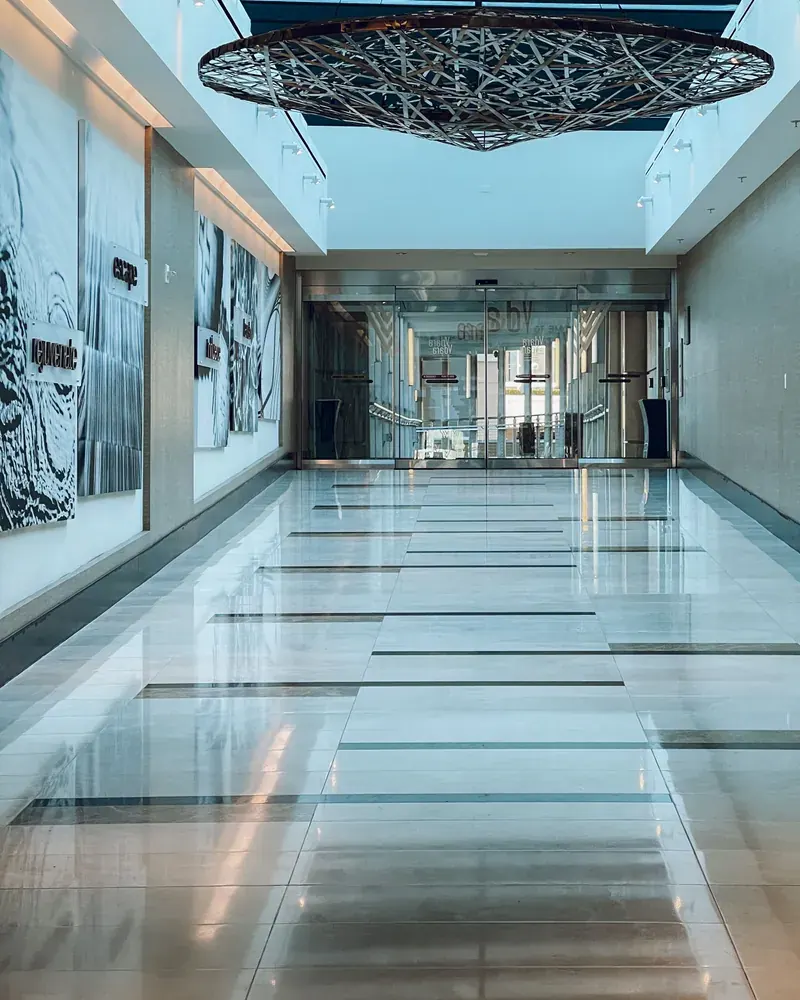
What the floor job covers
Base preparation through slab laying, grouting, sealing and final handover.
Base preparation
Level and repair the substrate before any mortar is spread.

Mortar bed laying
Correct bed thickness prevents hollow spots and slab fracture.

Slab installation
Align axes, maintain level, cut precisely around edges and obstacles.

Expansion joints
Flexible joints at walls and large fields stop arching and cracking.

Cleaning and grouting
Remove mortar residue and grout joints cleanly and uniformly.

Sealer application
Penetrating sealer blocks stains and rising moisture from below.
Materials and methods used
Sand-cement mortar bed
Semi-dry bed 40 to 60 mm thick distributes load and absorbs slab-level variation across the floor.
Flexible marble adhesive
High-flexibility adhesive withstands Kuwait's wide thermal movement without debonding over time.
Silicone expansion strip
Flexible strip placed at wall bases and every 6 metres in open areas absorbs floor movement seasonally.
Penetrating stone sealer
Penetrates marble pores to resist grease and stains without altering the surface appearance or sheen.
Common mistakes in marble floor laying
Thin or partial mortar bed
Insufficient bed thickness causes hollow-sounding slabs and fracture under point loads.
Omitting expansion joints
Without joints the floor arches upward in summer heat, popping slabs off the bed.
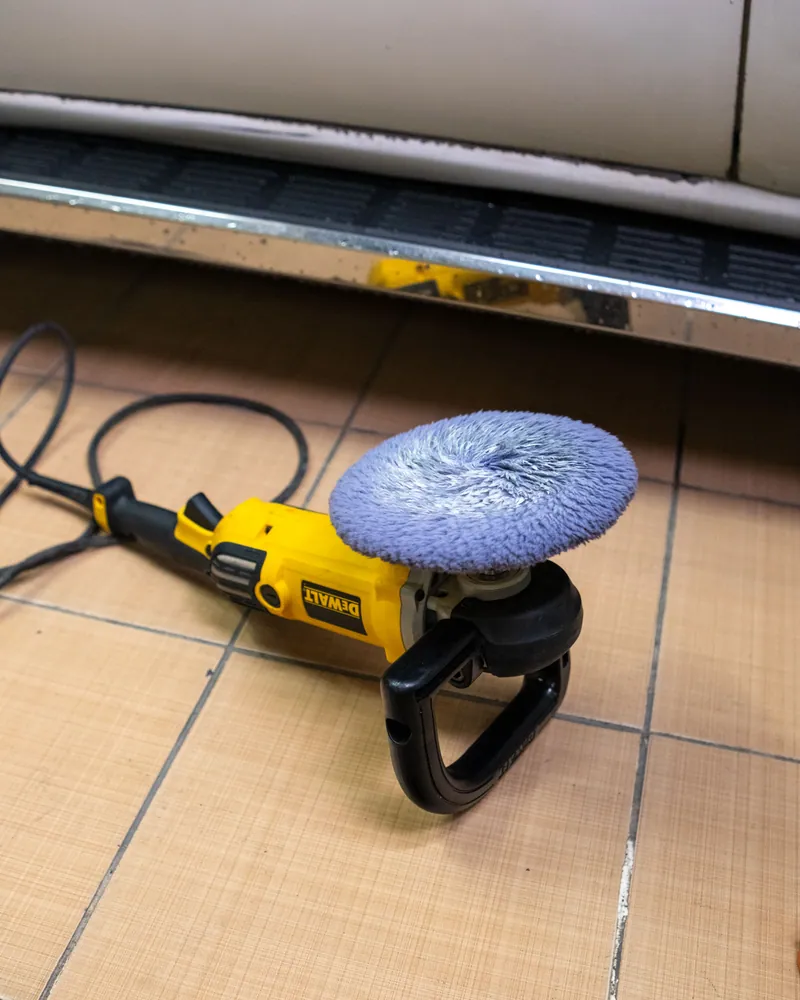
Polishing before full cure
Polishing before the mortar cures weakens bond and leaves grey shadow patches beneath the surface.
Skipping the sealer coat
Unsealed marble absorbs oil and stains immediately, and ordinary cleaning cannot remove them later.
More in marble & granite.





What goes wrong with most finishing.
The finish is what you see every day, and its mistakes do not hide. These three are the most common.
 01
01A rushed finish
The finish is what you live with every day. Rushing it shows in every corner.
 02
02Four contractors for one finish
Tiling, gypsum, paint and aluminium crews who never talk to each other.
 03
03After-care that never comes
Once you have the keys, it is hard to find anyone to come back and fix what shows up.
The solution?
Full finishing, and maintenance after it, from one licensed company.
A rushed finishTurnkey finishing
Marble, tiling, gypsum and paint from one company.

Four contractors for one finishOne company for every trade
No gaps between the tiler, the gypsum crew and the painter.

After-care that never comesRegular maintenance after handover
And finishing on instalments if you need it.
How it works.
Contact and survey
Call or WhatsApp to arrange an on-site visit and measurement.
Stone selection
We help you choose stone type, grade and floor layout pattern.
Quotation
Detailed quote covering materials, labour and prep works.
Installation
Base prep, mortar bed, slab laying, grouting and cleaning.
Sealing and handover
Sealer applied, quality check done, floor handed over ready for use.
What sets the price.
No fixed rate applies; these 5 factors shape every quotation for marble floor work.
Get a quoteStone type and grade
Imported Italian stone costs more than local or Turkish grades.
Total floor area
Larger areas reduce per-metre cost through bulk and installation efficiency.
Removing the existing floor
Breaking out the old floor and removing debris adds to project cost.
Layout complexity and cutting
Medallion patterns and angled cuts consume more time and material than straight laying.
Substrate condition
Cracked or uneven bases need repair work before any mortar is spread.
Why one contractor beats four.
Every extra contractor means another schedule and another excuse. With us, one company answers for all of it.
Turnkey
Shell and finishing with one company, from footings to keys.
Pay in instalments
Construction and finishing on instalments. Ask us for the details.
Engineering supervision
Architectural drawings and engineering supervision on site.
After handover
Maintenance contracts and a 24-hour emergency plumber.
A licensed Kuwaiti company for building construction, finishing, renovation and infrastructure works.
What our clients say.
See all reviews on GoogleExcellent
Taha Saad
Google review
Excellent
Ali Nadi
Google review
Marble flooring in Kuwait. We work across all six governorates of Kuwait: Capital, Hawalli, Farwaniya, Mubarak Al-Kabeer, Ahmadi, Jahra.
Official references: Kuwait Fire Force (safety requirements in finishing work)
Questions, answered.
Call nowWhat is the practical difference between 45-degree diagonal laying and straight laying for marble floors?
Diagonal laying at 45 degrees requires more edge cuts and higher material waste than straight laying. This increases both cost and time on site. Straight laying keeps waste minimal, while diagonal patterns need careful planning to keep cuts symmetrical.
Why do white hazy patches sometimes appear on marble after installation?
White haze is usually efflorescence, salts rising from the mortar bed through the pores before full curing. It can also result from cleaning with acidic products. A specialist stone treatment removes it, and applying a sealer early prevents recurrence.
Can marble flooring be installed in an uncovered outdoor area in Kuwait?
Yes, but outdoor marble faces intense UV and heat that fade some stone types over time. Choose a low-absorption variety, use an exterior-rated adhesive and apply a UV-resistant sealer to protect the surface.
How do I keep marble floors looking polished without frequent re-polishing?
A penetrating sealer applied right after installation is the most effective step. Clean regularly with pH-neutral products and avoid acidic cleaners such as vinegar. Felt pads under furniture legs also prevent the fine scratches that dull the surface fastest.
Should marble floors be laid before or after electrical and plumbing rough-in works are done?
Marble goes in after all in-slab electrical conduits and plumbing runs are complete and tested. Installing the floor first and then opening it for buried services damages the finished surface and wastes material.

Licensed and registered in Kuwait.
Check us before you sign. This is our licence number and what it covers.
Find us on Google Maps