
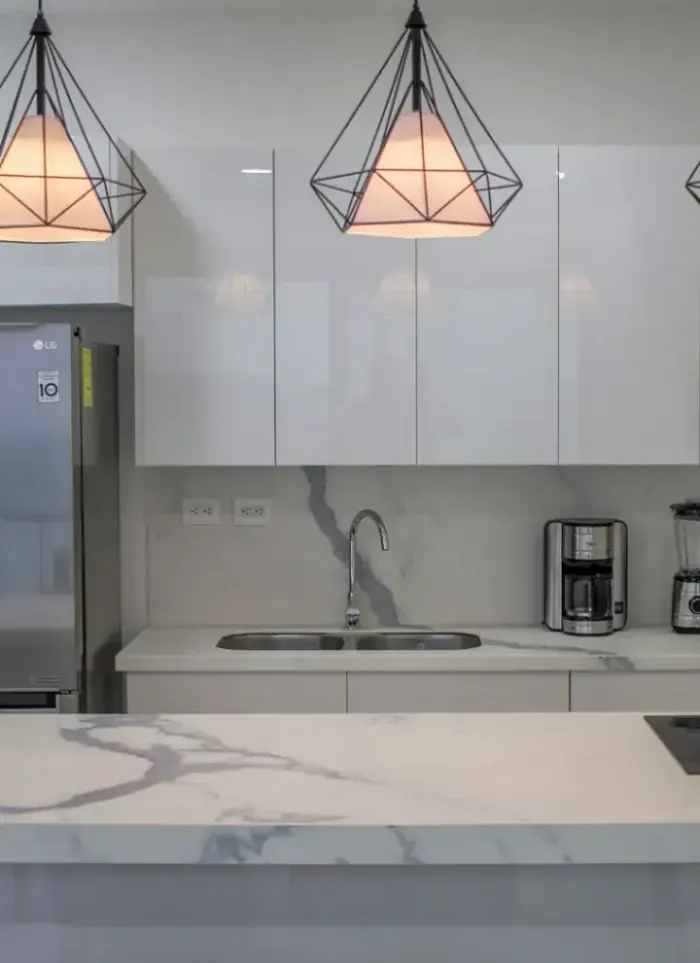
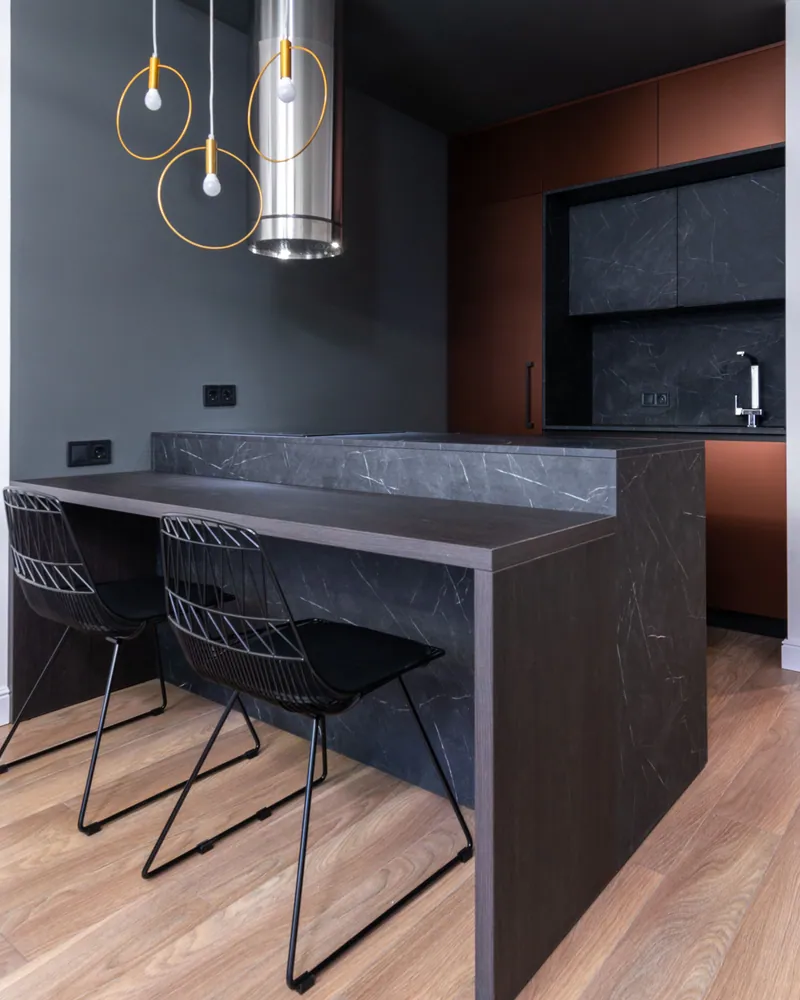
What the work covers
Measuring, cutting, profiling, fixing and sealing kitchen marble worktops from raw slab to handover.

Site templating
Exact on-site measurements taken before any slab is cut.

Slab cutting and shaping
Wet diamond saw cuts and shaped edges for sink and hob cutouts.

Edge profiling
Flat, bullnose or bevelled edge finish to match the kitchen design.
Fixing and joining
Epoxy adhesive fixing and colour-matched seam filling between slabs.

Sealer application
Full surface sealer coat applied to resist stains, oils and moisture.

Splashback and drainage
Sink perimeter and back edge sealed with anti-mould silicone.
Materials and methods used
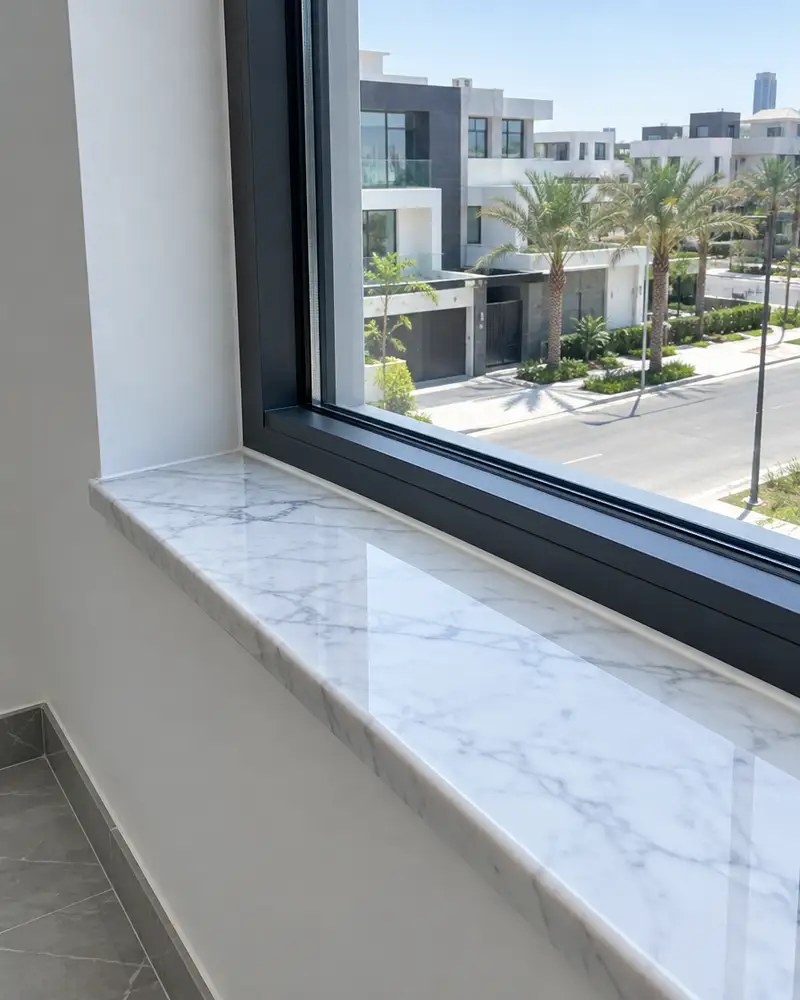
Calcatta and carrara marble
White veined slabs with sufficient hardness for daily Kuwaiti kitchen use and heat from cookware.
Two-part epoxy adhesive
Strong bond unaffected by kitchen humidity or heat; does not yellow under slab.
Penetrating stone sealer
Penetrates the stone pores and blocks oils and juices without altering the surface appearance.
Anti-mould silicone sealant
Applied at sink and wall junctions to stop moisture build-up and mould in Kuwait's humid kitchens.
Common mistakes in worktop installation
Dry cutting without water
Causes edge micro-cracks and releases harmful silica dust on site.
Skipping the sealer coat
Leaves the stone absorbing cooking oils and stains within the first week of use.
Poorly sealed sink joint
Water seeps under the slab and damages cabinet carcasses through constant moisture.
Unsupported overhangs
An unsupported overhang cracks under normal load pressure at the cantilever point.
More in marble & granite.

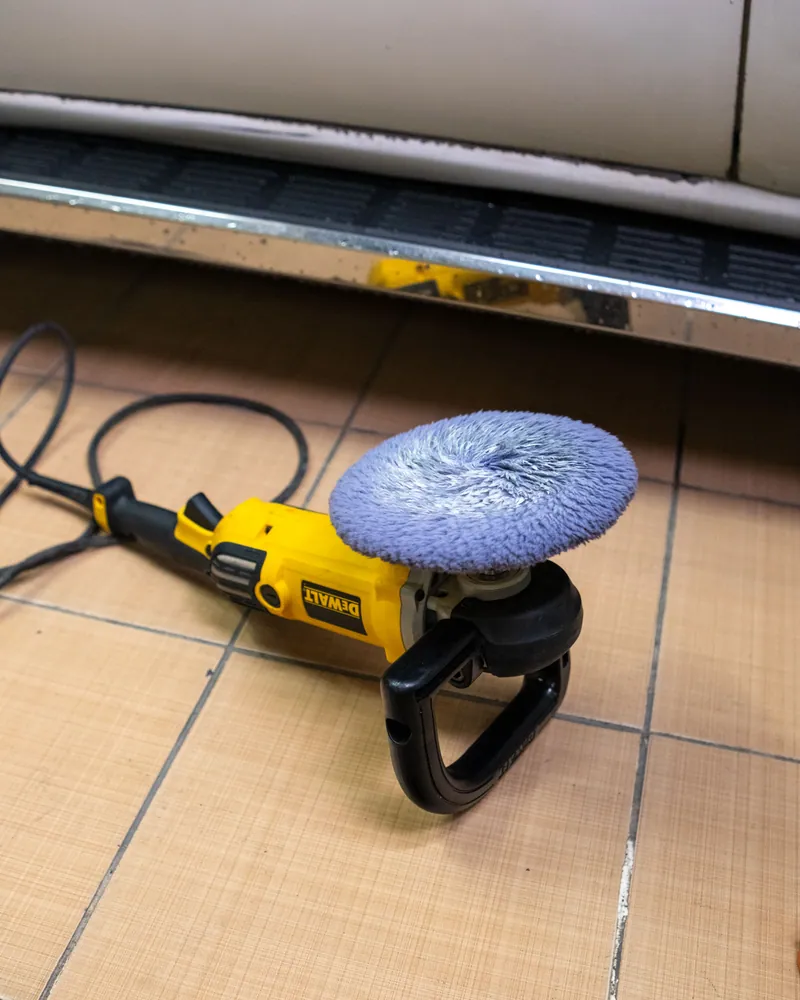


What goes wrong with most finishing.
The finish is what you see every day, and its mistakes do not hide. These three are the most common.
 01
01A rushed finish
The finish is what you live with every day. Rushing it shows in every corner.
 02
02Four contractors for one finish
Tiling, gypsum, paint and aluminium crews who never talk to each other.
 03
03After-care that never comes
Once you have the keys, it is hard to find anyone to come back and fix what shows up.
The solution?
Full finishing, and maintenance after it, from one licensed company.
A rushed finishTurnkey finishing
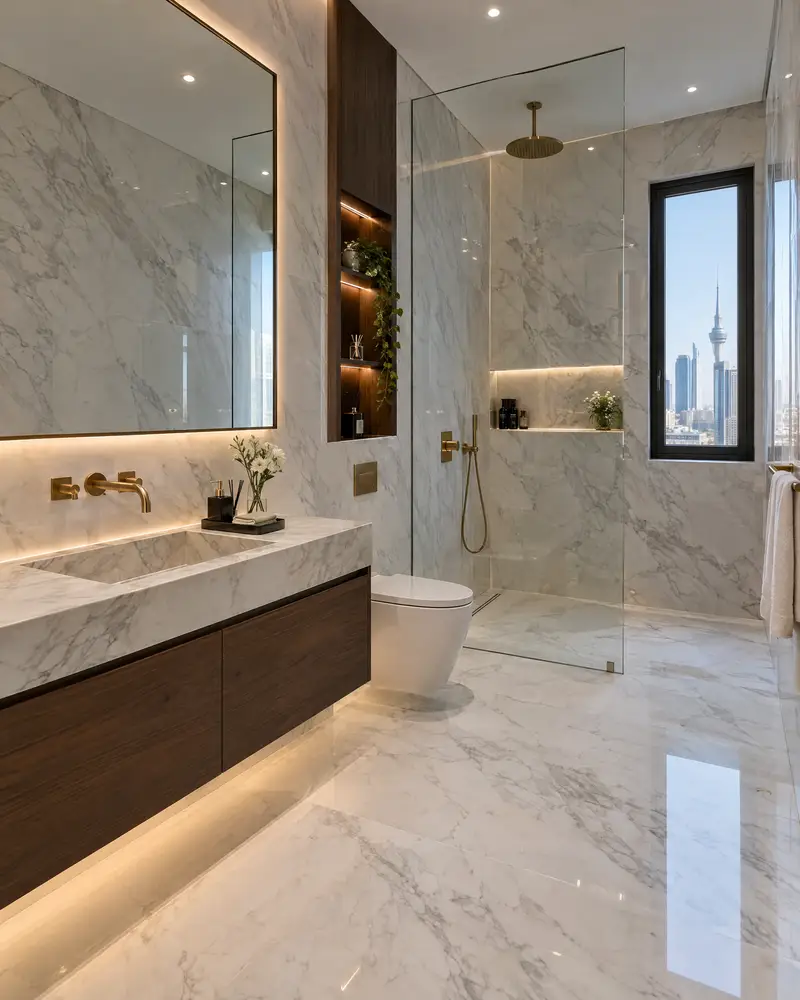
Marble, tiling, gypsum and paint from one company.

Four contractors for one finishOne company for every trade
No gaps between the tiler, the gypsum crew and the painter.

After-care that never comesRegular maintenance after handover
And finishing on instalments if you need it.
How it works.
Call or whatsApp
Send photos of your kitchen and we arrange a site visit.
Measuring and quote
Precise on-site measurements taken and a detailed quote issued.
Stone selection
You choose the slab and edge finish and approve a sample.
Cutting and fitting
Wet cutting, epoxy fixing and seam filling done on site.
Sealing and handover
Sealer applied, site cleaned and care instructions explained at handover.
What sets the price.
No fixed rate applies because several factors specific to your kitchen shape and stone choice drive the final cost.
Get a quoteStone type and grade
Grade A marble differs in price, hardness and porosity from commercial grade.
Total surface area
Net area in square metres after sink and hob cutouts are deducted.
Layout complexity
Internal corners, curves and mitre joints increase cutting time and stone waste.
Edge profile type
Hand-polished or bevelled edges take longer to finish than a straight flat edge.
Removal of existing worktop
Breaking out and removing an existing stone worktop is priced as a separate item.
Why one contractor beats four.
Every extra contractor means another schedule and another excuse. With us, one company answers for all of it.
Turnkey
Shell and finishing with one company, from footings to keys.
Pay in instalments
Construction and finishing on instalments. Ask us for the details.
Engineering supervision
Architectural drawings and engineering supervision on site.
After handover
Maintenance contracts and a 24-hour emergency plumber.
A licensed Kuwaiti company for building construction, finishing, renovation and infrastructure works.
What our clients say.
See all reviews on GoogleExcellent
Taha Saad
Google review
Excellent
Ali Nadi
Google review
Kitchen marble worktops in Kuwait. We work across all six governorates of Kuwait: Capital, Hawalli, Farwaniya, Mubarak Al-Kabeer, Ahmadi, Jahra.
Official references: Kuwait Fire Force (safety requirements in finishing work)
Questions, answered.
Call nowCan marble be installed directly over an existing worktop without breaking it out?
Usually not. Adding thickness raises the level and can block oven doors and built-in appliances. Cabinets are built to a fixed height. Full removal gives a proper base level and ensures a solid epoxy bond.
How do I treat an oil or turmeric stain on a marble worktop?
Blot immediately, do not rub. Apply a paste of plain white filler mixed with hydrogen peroxide over the stain and cover for several hours. A properly sealed surface resists most stains, but the sealer needs periodic re-application.
What is the practical difference between natural marble and engineered quartz for a kitchen surface?
Natural marble has a richer look but is more porous and needs sealing. Engineered quartz is harder and more stain-resistant but is a manufactured material, not natural stone. We offer both depending on the client's preference.
Does heat from pots and pans damage a marble worktop?
Yes. Direct thermal shock from a hot pot can leave a mark or hairline on the surface. Always use a trivet. The sealer protects against stains only; it does not provide heat resistance.
How many slabs does a typical kitchen worktop take and will the joints show?
An average kitchen typically needs 2 or 3 slabs depending on the layout. Joints are filled with colour-matched epoxy filler and polished flush, making them nearly invisible when done correctly.

Licensed and registered in Kuwait.
Check us before you sign. This is our licence number and what it covers.
Find us on Google Maps