
What the work covers
Substrate levelling through rectified tile fixing and joint sealing with a colour-matched compound.

Substrate levelling
Self-levelling compound applied to eliminate any height variation before fixing.

Rectified tile check
Tiles measured and sorted to confirm straight factory-cut edges before laying.

Clip-assisted fixing
Levelling clips and wedges set at every tile to keep the surface flush throughout.

Expansion joints
Flexible joints placed at wall perimeters and field breaks to absorb summer heat movement.

Micro-joint filling
High-density colour-matched compound fills the narrow joint and seals it against dust.

Clean-up and handover
Adhesive residue removed, surface polished, and every tile tap-tested before handover.
Signs this finish is what you need
Dust collecting in joints
Wide existing grout lines trap fine dust constantly and never clean fully no matter how often you mop.
Cracked or crumbling grout lines
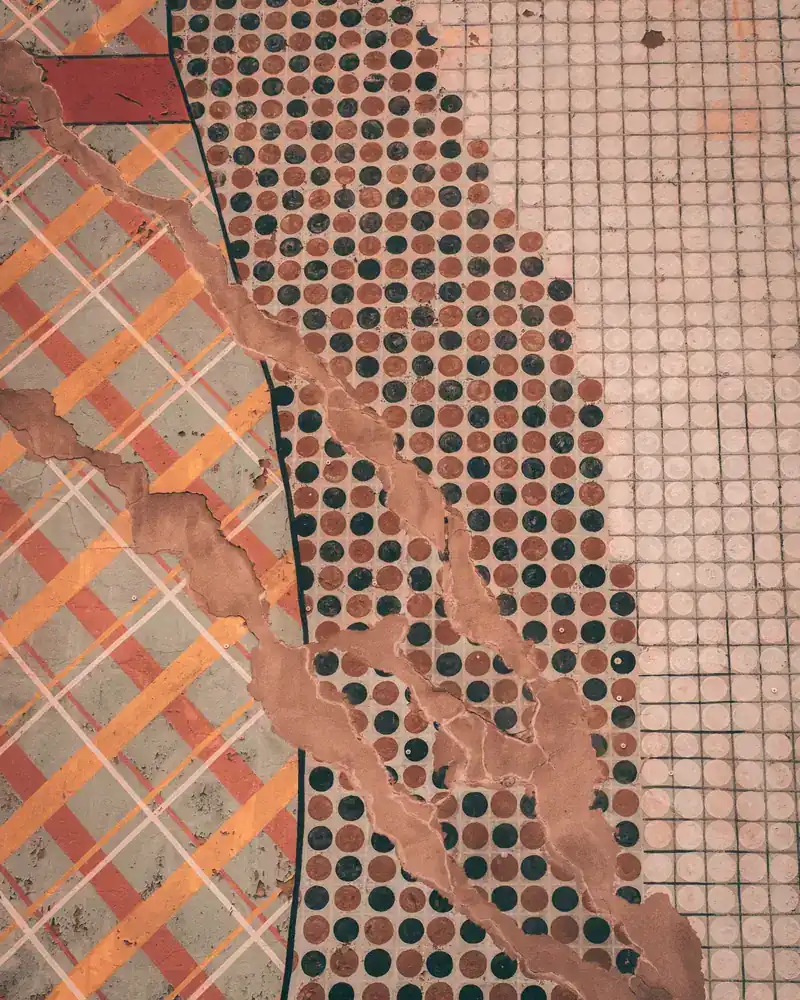
Existing floor grout is cracked and breaking up from thermal movement under Kuwait's intense summer heat.
Old tiles with wide joints
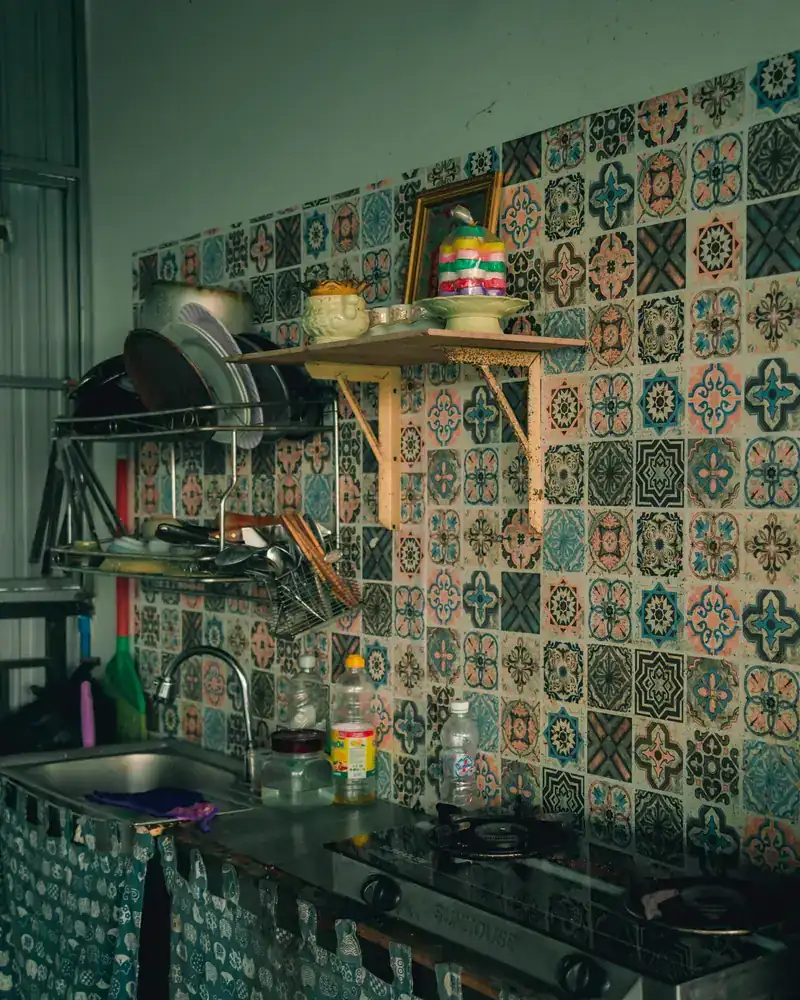
Tiles laid with thick joints give a dated look that stands out after a modern villa renovation.
Noticeably uneven floor surface
A step felt underfoot or raised tile edges pointing to a poor original levelling bed beneath.
Before you get in touch
Measure the actual area
Calculate square metres for each room planned, including corners, alcoves and entrance areas.
Decide the tile size
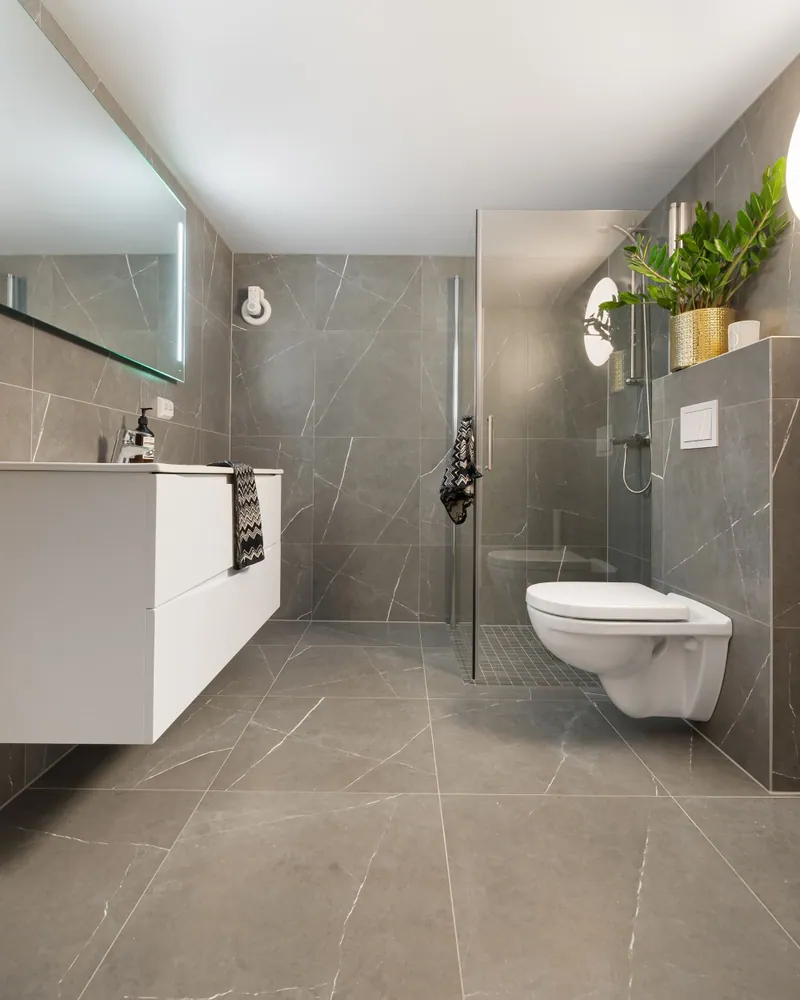
Large formats show the near-zero joint effect most clearly but need a flatter substrate to work.
Check the current floor condition
Tap existing tiles to find hollow spots or multiple layers that affect the final finished floor height.
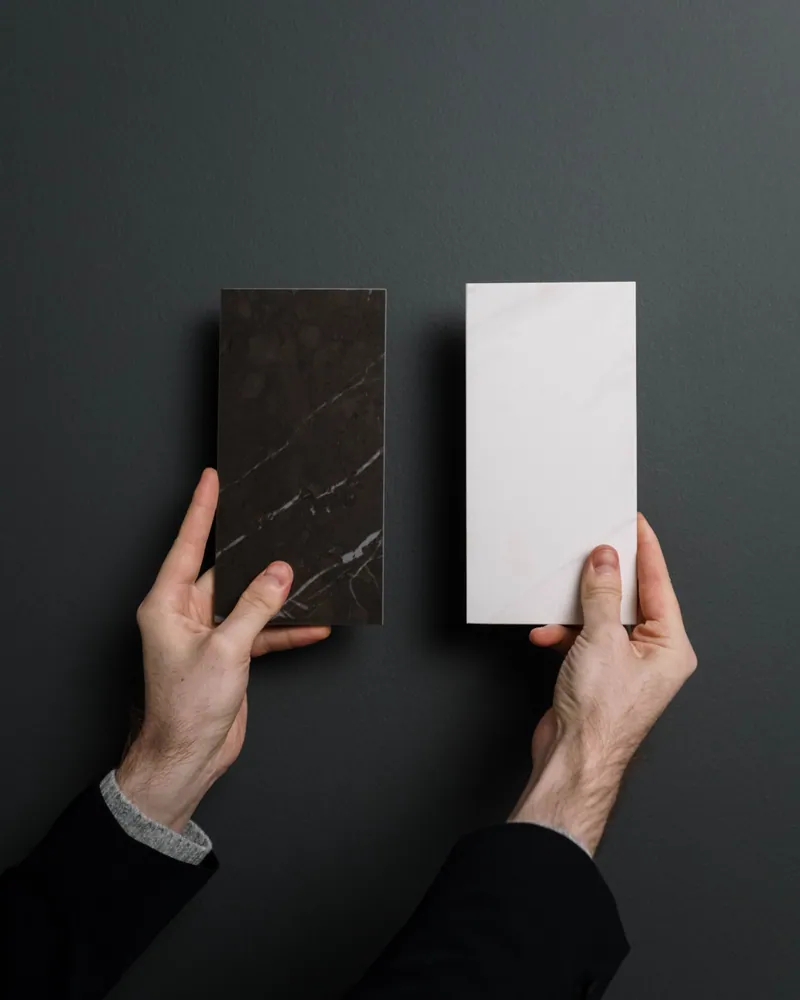
Gather colour and finish samples
Bring reference images or physical samples showing the finish tone and vein pattern you have in mind.
More in ceramic & porcelain tiling.
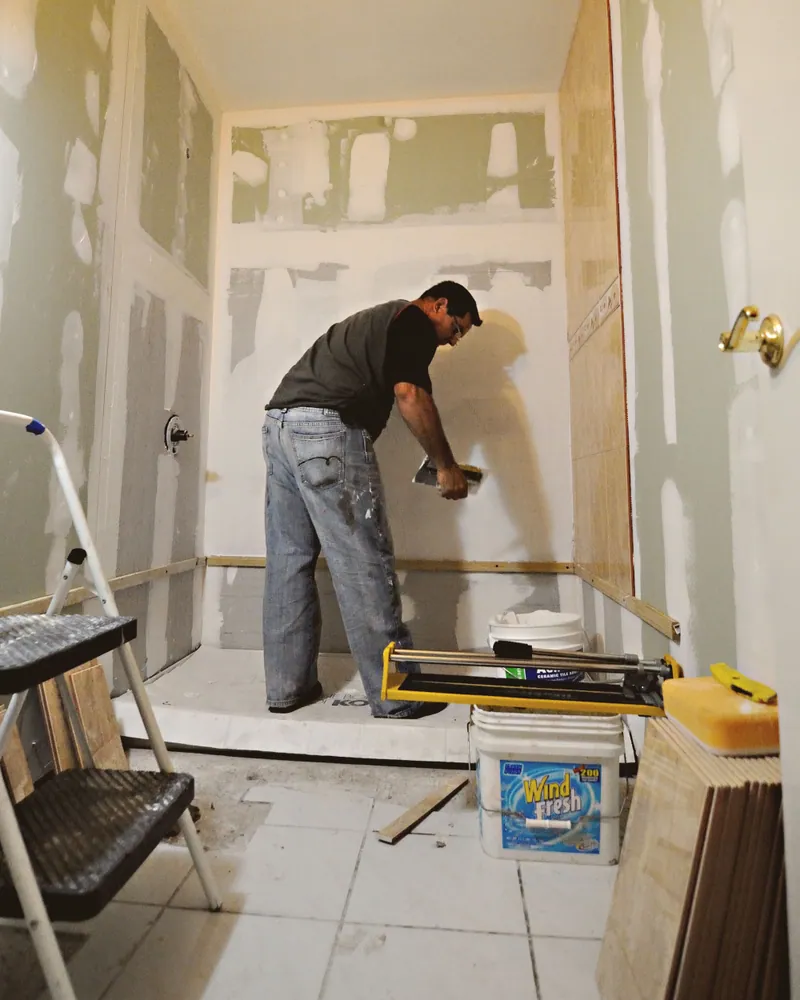
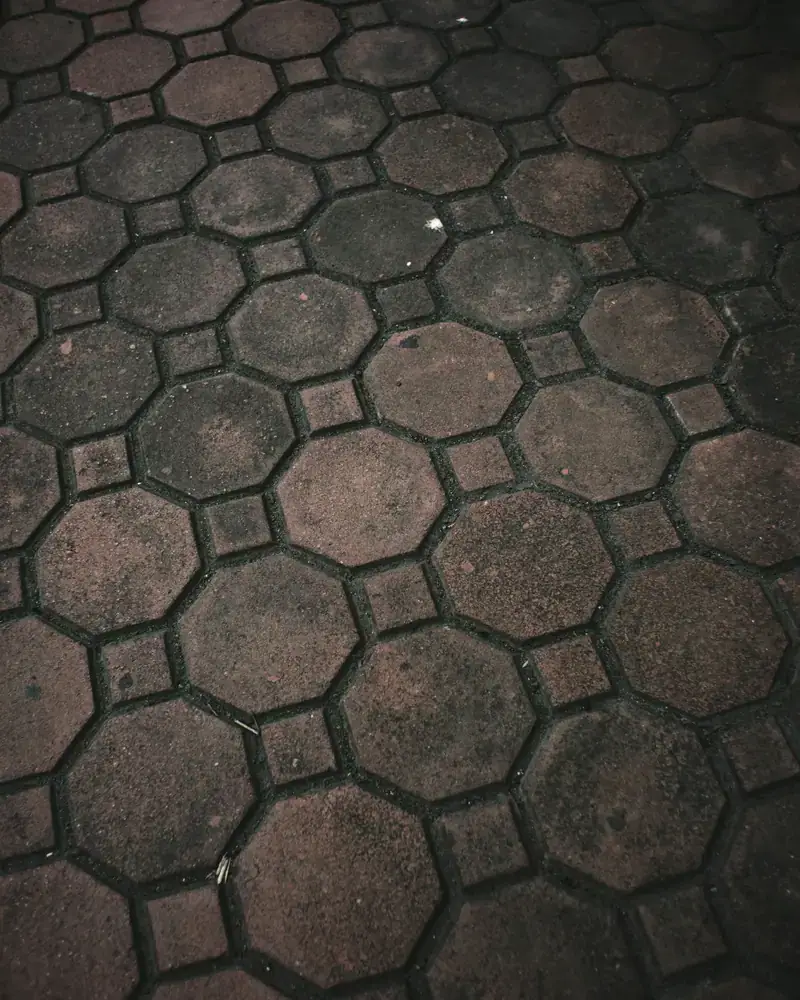
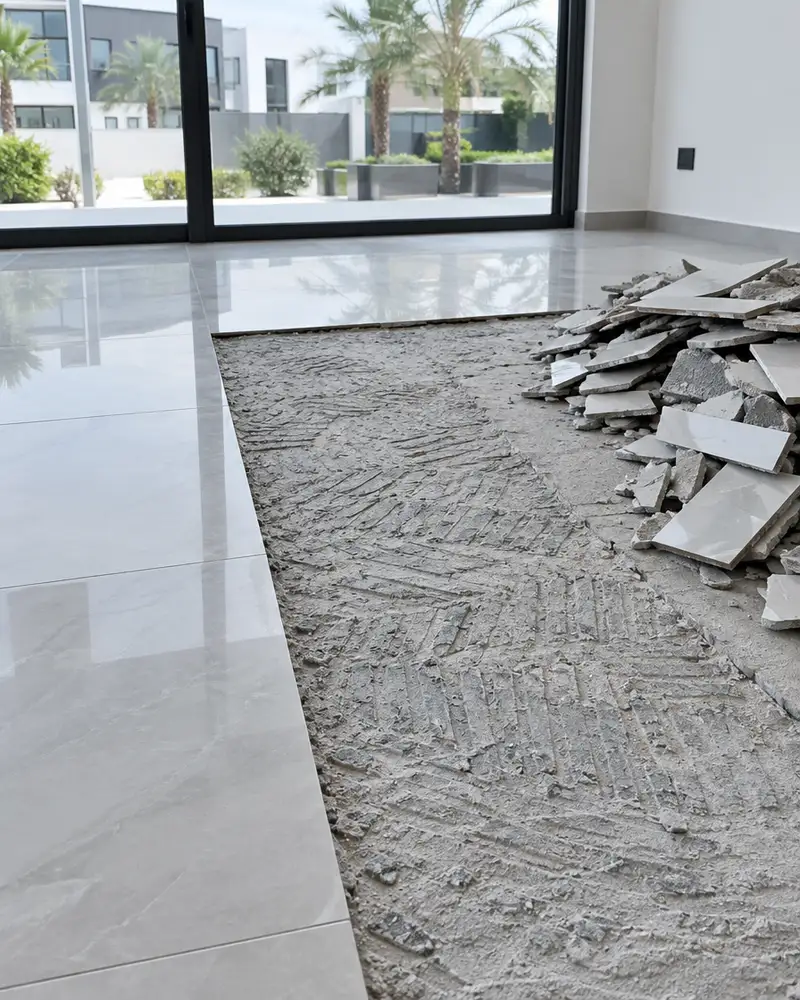
What goes wrong with most finishing.
The finish is what you see every day, and its mistakes do not hide. These three are the most common.
 01
01A rushed finish
The finish is what you live with every day. Rushing it shows in every corner.
 02
02Four contractors for one finish
Tiling, gypsum, paint and aluminium crews who never talk to each other.
 03
03After-care that never comes
Once you have the keys, it is hard to find anyone to come back and fix what shows up.
The solution?
Full finishing, and maintenance after it, from one licensed company.
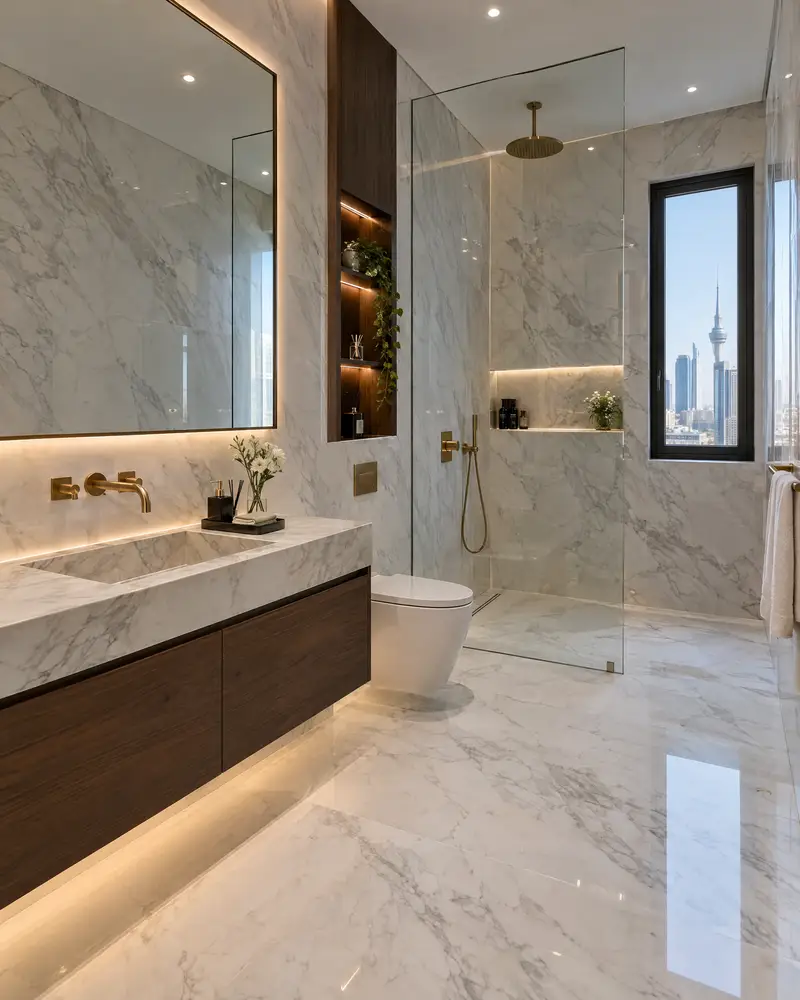
A rushed finishTurnkey finishing
Marble, tiling, gypsum and paint from one company.

Four contractors for one finishOne company for every trade
No gaps between the tiler, the gypsum crew and the painter.
After-care that never comesRegular maintenance after handover
And finishing on instalments if you need it.
How it works.
Call or whatsApp
Describe the project area and tile preference by phone or WhatsApp to start.
Site visit and survey
We visit to measure, check the substrate and recommend the right levelling solution.
Quotation
A detailed quote covering materials and labour is provided after the site survey.
Fixing and levelling
Base levelled, tiles fixed with clips, and micro-joints filled and colour-matched.
Inspection and handover
Every tile tap-tested, surface cleaned, and floor handed over ready for use.
What sets the price.
No fixed rate applies; the area size, tile format, substrate condition and joint compound type all shape the final quote.
Get a quoteTotal floor area
Total square meterage is the primary basis for materials and labour cost calculation.
Tile size and thickness
Large thick-format tiles need more adhesive coverage and more time for precise flat fixing.
Substrate condition
Uneven or cracked bases need an extra levelling layer that adds to preparation cost.
Existing tile removal
Removing old tiles and clearing the base adds labour and time before new laying begins.
Joint compound type
High-density or colour-matched filling compounds cost more than standard grout options.
Why one contractor beats four.
Every extra contractor means another schedule and another excuse. With us, one company answers for all of it.
Turnkey
Shell and finishing with one company, from footings to keys.
Pay in instalments
Construction and finishing on instalments. Ask us for the details.
Engineering supervision
Architectural drawings and engineering supervision on site.
After handover
Maintenance contracts and a 24-hour emergency plumber.
A licensed Kuwaiti company for building construction, finishing, renovation and infrastructure works.
What our clients say.
See all reviews on GoogleExcellent
Taha Saad
Google review
Excellent
Ali Nadi
Google review
Seamless porcelain in Kuwait. We work across all six governorates of Kuwait: Capital, Hawalli, Farwaniya, Mubarak Al-Kabeer, Ahmadi, Jahra.
Official references: Kuwait Fire Force (safety requirements in finishing work)
Questions, answered.
Call nowWhat is the practical difference between rectified and non-rectified porcelain for this type of installation?
Rectified tiles are factory-cut to exact dimensions with straight edges, allowing the joint to be reduced to near zero. Non-rectified tiles have slight dimensional variation that requires a wider joint to accommodate the difference, so they are not suitable for this finish.
Does the floor always need a levelling layer before near-zero joint porcelain is fixed?
In most cases yes. Large-format tiles do not hide substrate variation; they highlight it. A self-levelling layer ensures a flat base that prevents tile cracking and raised edges appearing later under foot traffic.
Do expansion joints still need to be placed when the tile joint is kept extremely narrow?
Yes, and this is critical in Kuwait. The narrow tile joint does not replace flexible expansion joints at wall perimeters and field breaks. Summer heat expands large porcelain slabs and without these joints the whole installation will crack.
Can near-zero joint porcelain be installed in wet areas such as bathrooms?
Yes, provided a water-resistant filling compound is used and a waterproofing membrane is applied to the substrate before tiling. The narrow joint actually reduces water ingress compared to wide conventional grout lines in a bathroom floor.
How is near-zero joint porcelain maintained over time in a Kuwaiti home?
Cleaning is considerably easier because dust has no wide joint to settle in. Avoid strong acid cleaners that break down the filling compound, and reseal the perimeter expansion joint lines periodically to keep the finish intact over the years.

Licensed and registered in Kuwait.
Check us before you sign. This is our licence number and what it covers.
Find us on Google Maps