
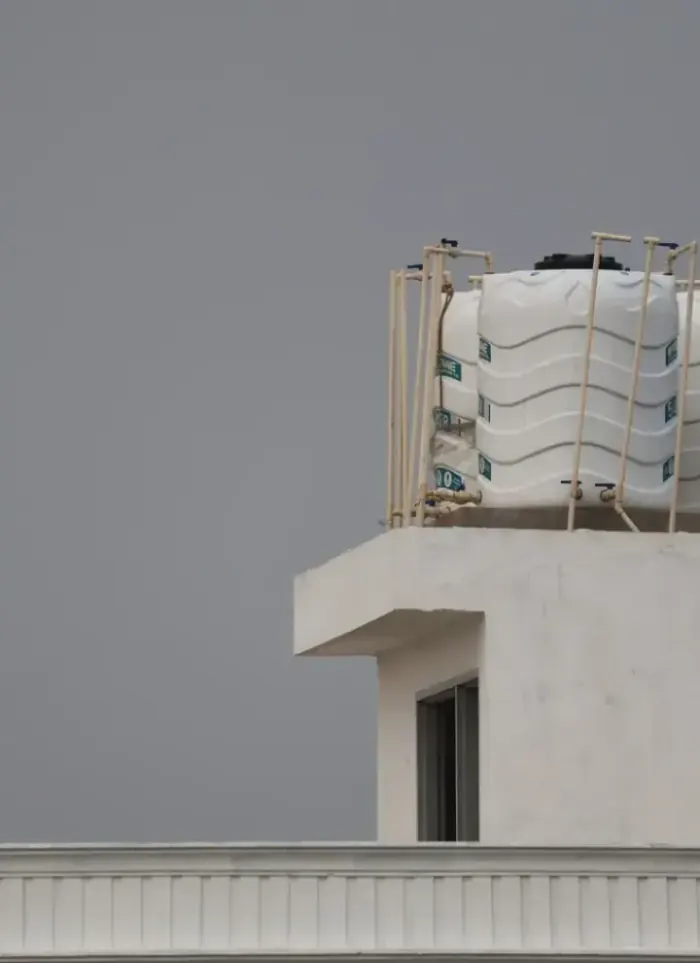

What the service covers
Roof tank supply and fit, from frame installation through to pressure testing and commissioning

Roof tank installation
Tank secured to a steel frame sized for the roof slab.

Inlet and outlet connections
PPR supply, draw-off and overflow lines run and fused.

Float valve fitting
Level-control float valve fitted and adjusted to stop overflow.

Isolation valves
Isolation valves on supply and draw-off lines for future maintenance.

Pressure test
System filled and every joint checked before handover.

Old tank replacement
Old tank removed, frame inspected and new tank installed.
Signs your roof tank needs replacing or fitting
Weak pressure upstairs
Upper floors get a weak flow, pointing to an undersized or incorrectly positioned roof tank.
Cracked or leaking tank
Damp patches around the tank base or on the roof surface below indicate a failing tank wall.
Rust or odour in the water
Discoloured or odd-smelling tap water points to internal tank deterioration needing urgent replacement.
Corroded or tilted frame
A rusted or visibly tilted steel frame puts the tank at risk of collapse and must be addressed immediately.
Check these before you call
Required tank capacity
Know the number of occupants and floors so the right tank size can be quoted.
Current frame condition
Visually check the existing steel frame for rust, cracks or any visible tilt before the visit.
Roof pipework material
Know whether existing roof pipes are PPR or galvanised iron to help plan the connection work.
Tank position on the roof
Identify the intended position and whether a crane or manual carry is needed to place the new tank.
Inside water tank installation.
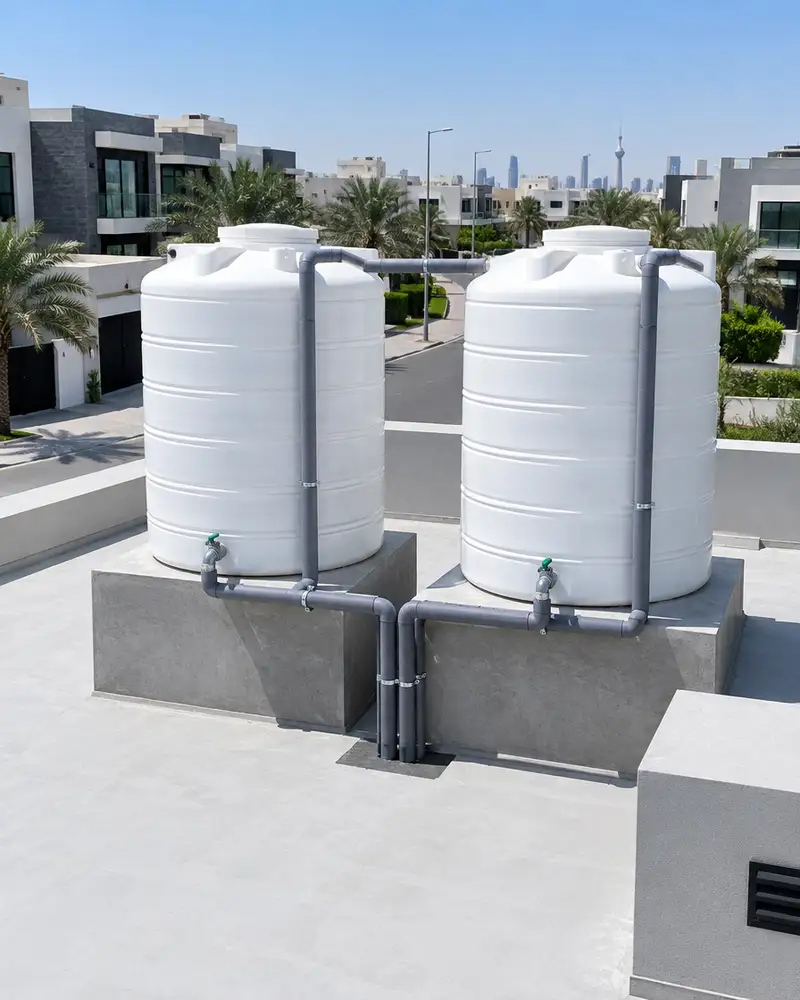
How a roof tank installation is done correctly in Kuwait
Work begins with a roof survey to confirm that the slab can carry the full weight of the tank, since a tank filled with water is considerably heavier than it appears empty. The steel support frame is fixed to the concrete roof slab with chemical anchor bolts, then given a rust-resistant coating before the tank is lifted into place. Getting this stage right prevents the frame tilting over time under Kuwait's thermal cycling.
Once the tank sits level on the frame, PPR pipe runs are heat-fused for the supply line from the transfer pump, the draw-off line feeding the building, and the overflow outlet. The overflow must be directed to a safe discharge point away from walls, as Kuwait's hard water leaves calcium staining wherever standing water evaporates. Isolation valves are fitted on each line so any future maintenance can be done without draining the whole network.
Before handover, the tank is filled and every joint and connection is inspected under live water pressure. The float valve and transfer pump are tested together to confirm the pump cuts out when the tank reaches its set level. A record of valve positions and pipe routes is noted so future maintenance teams can work safely without guesswork about what lies behind finished surfaces.
What goes wrong with most plumbing.
Plumbing problems start hidden and end with breaking tiles. These three cost the most.
 01
01Pipes laid in a rush
Pipework rushed before the walls close stays hidden until it starts to leak.
 02
02Leaks you cannot see
A slow leak behind tiles shows up as damp, stains and a higher water bill.
 03
03Nobody answers in an emergency
A burst pipe at night cannot wait for a contractor who has moved on.
The solution?
Pipework, leak detection and maintenance from one licensed company.
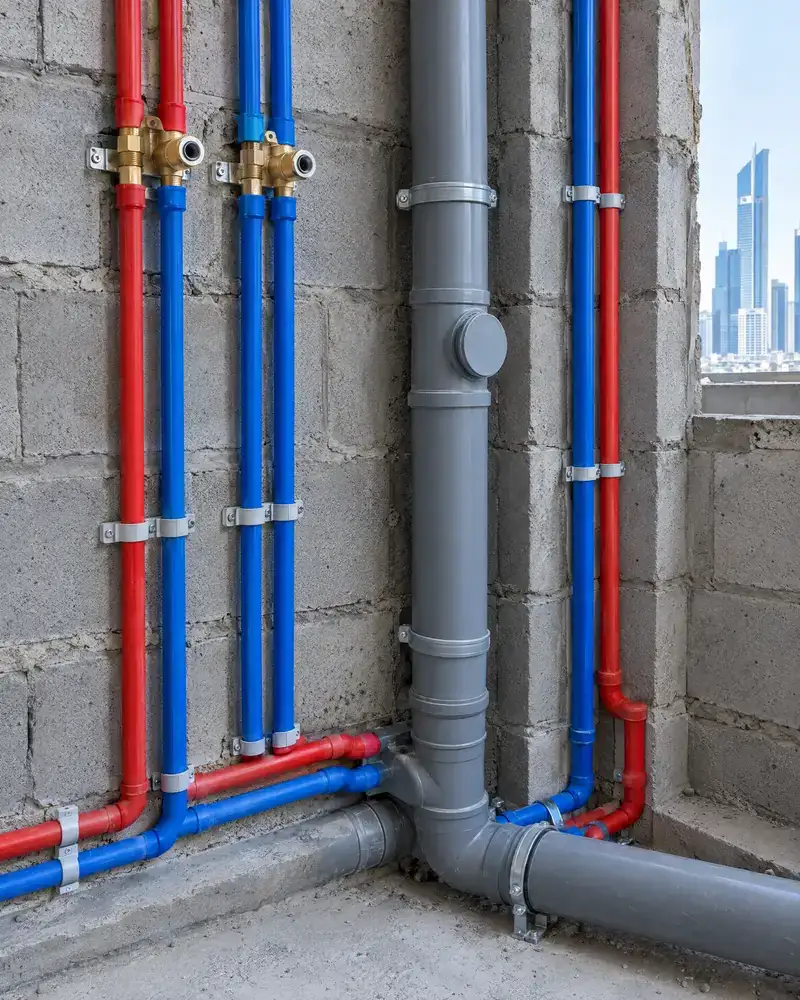
Pipes laid in a rushFirst-fix plumbing by the builder
Laid as part of the build, before the walls close.

Leaks you cannot seeWater leak detection
We find the source first.
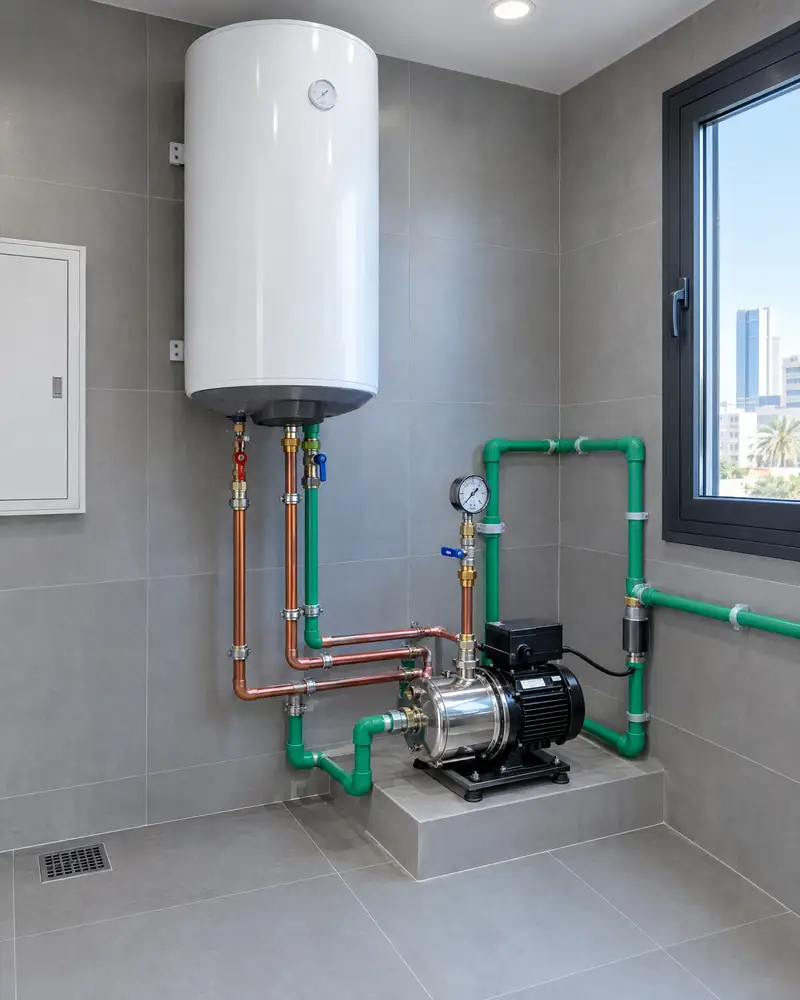
Nobody answers in an emergency24-hour emergency plumber
Plus regular maintenance contracts after handover.
How it works.
First contact
Call or WhatsApp us with photos of the roof and existing tank.
Roof survey
Technician inspects the roof, frame and existing pipework on site.
Quotation
Detailed quote covering tank, frame, pipe runs and connections.
Installation
Frame fixed, tank placed, PPR lines fused and valves fitted.
Test and handover
Tank filled, joints pressure-checked, float valve set and handed over.
Tank capacity and type
Larger tanks and insulated fibreglass units cost more than small polyethylene ones.
Frame condition and spec
A new or rebuilt frame adds cost compared with reusing a sound existing one.
Roof pipe run length
Longer PPR runs from pump to tank and down to distribution increase material and labour cost.
Roof access difficulty
High roofs needing a crane or scaffolding to lift the tank raise the installation cost.
Additional works required
Removing an old tank and repairing prior pipe or slab damage adds to the overall cost.
Why one contractor beats four.
Every extra contractor means another schedule and another excuse. With us, one company answers for all of it.
Turnkey
Shell and finishing with one company, from footings to keys.
Pay in instalments
Construction and finishing on instalments. Ask us for the details.
Engineering supervision
Architectural drawings and engineering supervision on site.
After handover
Maintenance contracts and a 24-hour emergency plumber.
A licensed Kuwaiti company for building construction, finishing, renovation and infrastructure works.
What our clients say.
See all reviews on GoogleExcellent
Taha Saad
Google review
Excellent
Ali Nadi
Google review
Water tank installation in Kuwait. We work across all six governorates of Kuwait: Capital, Hawalli, Farwaniya, Mubarak Al-Kabeer, Ahmadi, Jahra.
Official references: Ministry of Electricity and Water (water and drainage connections)
Questions, answered.
Call nowWhat is the difference between a polyethylene and a fibreglass roof tank?
Polyethylene tanks are lighter and less expensive, but their thin walls allow water to heat up quickly during Kuwait's summers. Double-wall insulated fibreglass tanks keep water cooler for longer and are worth specifying for buildings where cold-water temperatures during summer months are a concern.
Can a second tank be added alongside an existing roof tank?
A second tank can be installed and plumbed in parallel with the existing one, provided the roof slab can carry the combined full load. Each tank gets its own isolation valve so either unit can be serviced independently without interrupting the water supply.
Why does the cold-water supply get hot in summer even from the roof tank?
Uninsulated polyethylene tanks exposed to direct sun absorb heat rapidly in Kuwait's summer and can bring cold supply lines to high temperatures. Switching to an insulated double-wall fibreglass tank or shading the existing tank with a thermal cover significantly reduces the problem.
How is the right roof tank size determined for a two-storey house?
Tank size is based on the expected daily consumption of all occupants plus a reserve margin to cover supply interruptions. The general approach is to specify enough storage to keep the building supplied for at least one full day of normal use without any fresh input from the ground tank.
How does Kuwait's hard water affect the roof tank connections?
Kuwait's high mineral content causes scale to build up inside the float valve seat and at the tank inlet fitting, eventually causing overflow or a valve that no longer shuts off correctly. Periodic inspection and descaling of the float valve and inlet connections keeps the system working as intended.
Can a tank be installed on an older roof without strengthening the slab?
The concrete slab must be assessed before any tank is placed on an older roof, since a full water tank exerts a significant concentrated load. If the slab check raises doubts about capacity, a structural engineer should confirm adequacy before installation proceeds to avoid long-term slab damage.

Licensed and registered in Kuwait.
Check us before you sign. This is our licence number and what it covers.
Find us on Google Maps