
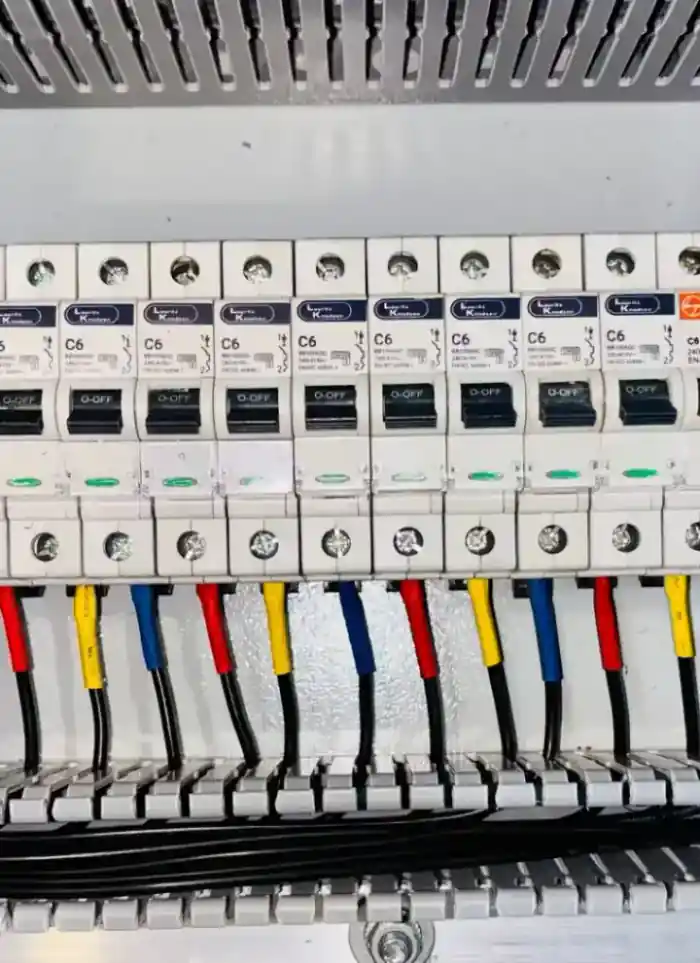
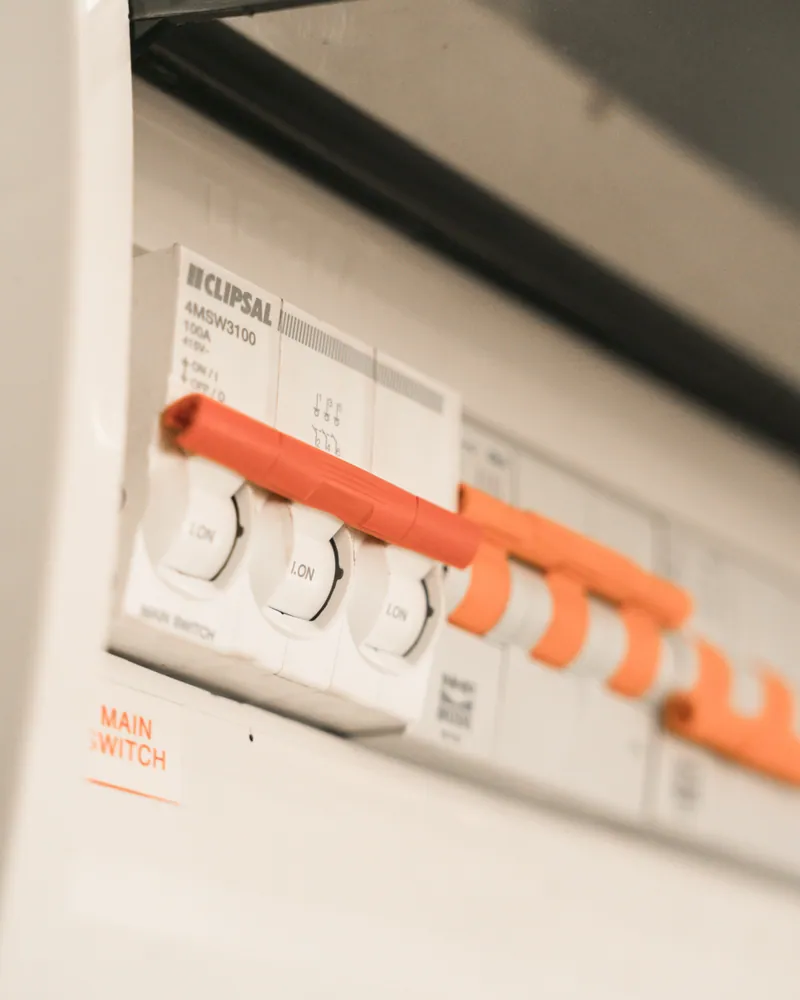
What the installation covers
Load assessment, board mounting, breaker selection, circuit termination and labelling to a consistent standard
Load assessment
Calculating AC and appliance loads to size the board correctly
Breaker selection
Matching each breaker rating to its circuit's cable and load

Board mounting
Fixing the enclosure securely with all conduit entries sealed
Residual current protection
Fitting RCD breakers on wet areas, outdoor circuits and pools
Earth connections
Connecting earth conductors to every breaker and the main earth bar
Circuit labelling
Labelling every breaker with its room or load for easy future maintenance
Materials and methods used
High breaking-capacity MCBs
Withstand short-circuit currents without burning, essential for Kuwait's high-load buildings
Combined RCBO units
Merge residual current and overcurrent protection in one unit to save rail space
Metal enclosure with IP65 sealing
Protects components from fine dust and coastal humidity common in Kuwait's environment
Copper busbar and terminal blocks
Deliver current at low resistance and allow new circuits to be added later
Common mistakes in board installation
Undersized main breaker
Main breaker runs near its limit constantly, wears faster and trips in summer peak load
Mixing loads on one circuit
Putting AC, lights and sockets on one breaker causes trips during any load peak
No RCD on wet area circuits
Bathrooms, kitchens and pools without RCD protection create a direct electrocution hazard
Cables entering without conduit
Bare cable at the enclosure entry chafes on the metal edge causing a gradual short
More in electrical works.



What goes wrong with most finishing.
The finish is what you see every day, and its mistakes do not hide. These three are the most common.
 01
01A rushed finish
The finish is what you live with every day. Rushing it shows in every corner.
 02
02Four contractors for one finish
Tiling, gypsum, paint and aluminium crews who never talk to each other.
 03
03After-care that never comes
Once you have the keys, it is hard to find anyone to come back and fix what shows up.
The solution?
Full finishing, and maintenance after it, from one licensed company.
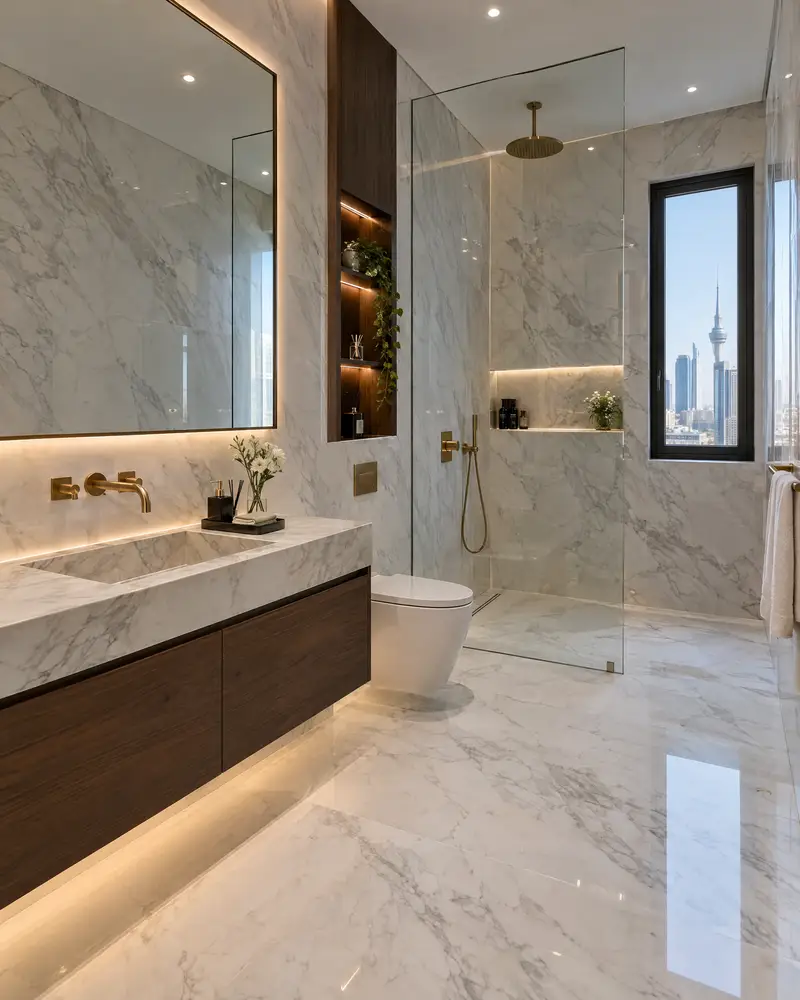
A rushed finishTurnkey finishing
Marble, tiling, gypsum and paint from one company.

Four contractors for one finishOne company for every trade
No gaps between the tiler, the gypsum crew and the painter.

After-care that never comesRegular maintenance after handover
And finishing on instalments if you need it.
How it works.
Call or message
Call or WhatsApp us to describe your building and board requirements
Site survey
Our engineer visits to count loads, assess existing cables and confirm board location
Quotation
We submit a detailed quote listing board spec, breaker types and installation method
Installation
We mount the enclosure, terminate all cables and fit breakers with full earthing
Testing and handover
We test each circuit under real load, label every breaker and hand over the board
What sets the price.
No fixed rate applies; these factors shape the quote for your specific project
Get a quoteCircuit count
AC, lighting and socket circuits determine board size and breaker count
Breaker types required
Standard MCBs cost less than combined RCBO units with residual current protection
Replacement vs new install
Replacing an existing board requires disconnecting and carefully re-terminating live cables
Board location and access
Boards in ceilings or tight enclosures take longer to mount and terminate
Associated works
Running new conduit or patching walls after installation raises the overall cost
Why one contractor beats four.
Every extra contractor means another schedule and another excuse. With us, one company answers for all of it.
Turnkey
Shell and finishing with one company, from footings to keys.
Pay in instalments
Construction and finishing on instalments. Ask us for the details.
Engineering supervision
Architectural drawings and engineering supervision on site.
After handover
Maintenance contracts and a 24-hour emergency plumber.
A licensed Kuwaiti company for building construction, finishing, renovation and infrastructure works.
What our clients say.
See all reviews on GoogleExcellent
Taha Saad
Google review
Excellent
Ali Nadi
Google review
Distribution board installation in Kuwait. We work across all six governorates of Kuwait: Capital, Hawalli, Farwaniya, Mubarak Al-Kabeer, Ahmadi, Jahra.
Official references: Kuwait Fire Force (safety requirements in finishing work)
Questions, answered.
Call nowHow many circuits does a typical villa in Kuwait need?
It depends on floor area and AC unit count. A mid-size villa typically needs a separate circuit for each AC unit, dedicated circuits for lighting per floor, and general socket rings, putting most projects between 20 and 40 circuits or more.
Can the distribution board be replaced without cutting power to the whole villa?
Replacing the main board requires isolating the supply at the main breaker during installation. Preparation work done beforehand, such as sorting and labelling cables, keeps the actual power-off period as short as possible.
What is the difference between a standard MCB and an RCD breaker?
A standard MCB protects against overload and short circuit only. An RCD detects any leakage current to earth and trips within milliseconds, protecting people from electric shock in wet areas such as bathrooms and kitchens.
Does each central AC unit need its own dedicated circuit?
Yes. Central AC units draw high inrush current on startup, and sharing a circuit with other loads causes the breaker to trip. A dedicated circuit with a correctly rated breaker for each unit is the standard practice.
Can new breakers be added to an existing board at a later stage?
Yes, if the board has spare positions on the busbar and the main breaker can carry the added load. If the board is full or the main breaker is already at capacity, replacing it with a larger unit becomes the practical solution.
Licensed and registered in Kuwait.
Check us before you sign. This is our licence number and what it covers.
Find us on Google Maps